(This article is intended for C-Suite SaaS leaders who are leveraging MCP to create adoption & stickiness with their platforms; if that not’s you, feel free to skip this article.)
Be cognizant around what your MCP is exposing to ensure your IP is protected.
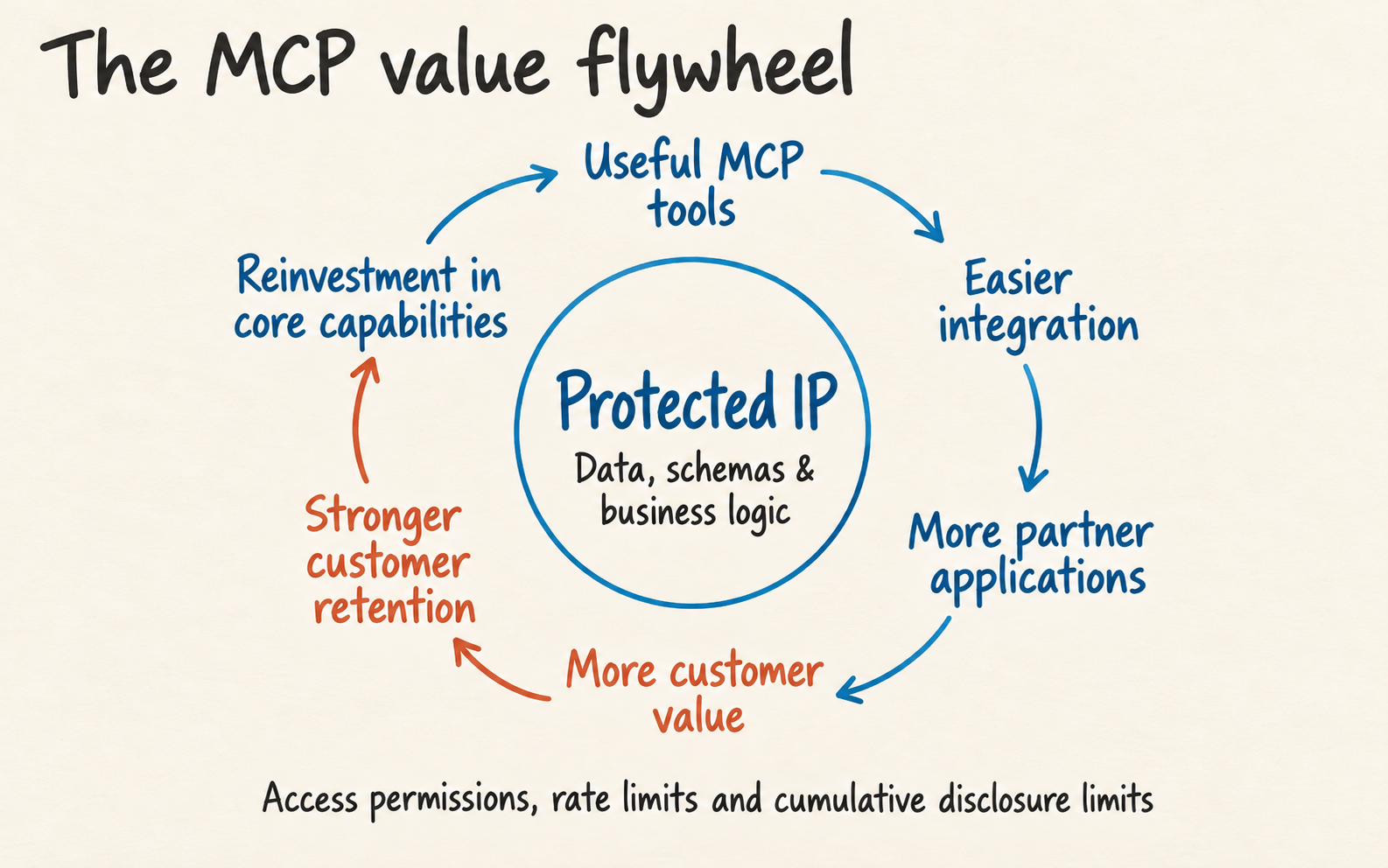
As a C-Suite leader for a Saas company, you want 3P developers to find it easy to build around a product, because a useful integration can extend its reach into workflows beyond the company's own development capacity. As customers incorporate those workflows into their daily operations, they gain more value from the product and have more to consider before replacing it. The difficulty is deciding how much of the business to expose (essentially your Intellectual Property) in exchange for that distribution, especially when the same access that helps a partner serve your customers can help it reproduce capabilities you spent years developing. That decision should shape the MCP (Model Context Protocol) architecture from the beginning.
MCP gives AI applications a common way to discover and use tools and data, reducing the work required to connect them For a pricing company, that makes it easier for a partner to build a sales assistant that obtains a quote, routes it through the customer's approval process, and carries the approved terms into an order. The partner contributes its own development resources and distribution, while the customer gains a process that previously required people to move between systems. Making that connection easy lets your pricing capability become useful across a larger part of the customer's business, which is exactly the kind of expansion an ecosystem should support.
As employees come to rely on the workflow, replacing your product involves preserving the surrounding process, including the accuracy of the quotes and the reliability of the approvals. That gives the customer more value to lose in a migration and gives your company a reason to invest in making partners successful. Research on public APIs supports the broader business case: Seth Benzell, Jonathan Hersh, and Marshall Van Alstyne found greater market-value growth among adopters attracting more developers of complementary applications, alongside increased breach risk from public API adoption. For CEOs, CTOs, CPOs, and Chief AI Officers, the opportunity and the exposure need to be evaluated together, because the same access contributes to both.
You should evaluate that stickiness by looking for the recurring reason a partner needs the business. The common protocol that makes your product easier to adopt also reduces part of the work involved in connecting a competing product, even though their permissions and business behavior will differ. What matters is whether the partner continues to need something your business does exceptionally well. An assistant that returns for a fresh quote because your service evaluates current costs and commercial constraints creates a continuing relationship; an assistant that copies everything needed to calculate those quotes elsewhere leaves you with a different economic position. Both might appear as successful integrations on the same dashboard, however they result in two very different exposure rates of your business IP.
This is why the distinction between an external tool schema and an internal data schema matters well beyond engineering. The external schema tells a developer what a tool accepts and returns; MCP's input schema and optional output schema describe that contract independently of the database structure behind it. In the pricing example, the partner needs to know how to request an authorized quote and interpret its terms, while your platform can retain the supplier costs, rebate relationships, and margin thresholds used to produce it. Exposing those internal relationships because they happen to be convenient for the first integration turns an implementation shortcut into a decision about how much of your commercial logic another business can understand. The names and descriptions in the tool catalogue deserve the same scrutiny, since they can reveal sensitive capabilities before a tool runs, and MCP allows that catalogue to reflect the caller's authorization
A well-designed quoting tool performs the calculation inside your service and returns the price, terms, and expiration the workflow requires. Google describes a related approach in its MCP guidance for databases, using a specific order lookup whose user filter is set outside the agent's control. That design puts identity and permissions in the service, where they can be enforced on every request, and leaves the agent to select among actions the user is allowed to perform. The quoting service can apply the same principle to its internal fields, ensuring that the partner receives the approved result while the inputs used to calculate it remain under the service's control.
The same reasoning should determine what your product means by a full read. A partner requesting the complete quote needs the complete representation it is authorized to receive, which your service should assemble from approved fields and validate before release, consistent with OWASP's guidance. Internal fields added later should remain private until deliberately included, and the restriction must hold across nested records, attachments, and text responses so each representation preserves the same boundary. Authorizing the read and checking the fields returned on every call makes the approved product contract an enforced limit on disclosure, including when an agent follows a request to retrieve more information.
A clear interface makes those boundaries easier for partners to work within, because a stable quoting tool saves a partner from learning your database relationships, while clear schemas, working examples, and realistic test data let its developers build without repeatedly asking your engineers for help. Anthropic recommends tools organized around useful workflows, and Meta's internal Capacity Efficiency platform demonstrates how reusable MCP tools can support additional applications by composing existing tools and reusing integrations. My takeaway is that a company can protect more of its implementation while making its capabilities easier to use, provided it gives the external interface its own product design and engineering investment (and not just on a surface-level basis).
That approach reaches its limit when the abstraction excludes work customers genuinely need. A partner building analytics may require historical transactions and flexible filters that a quote-generation tool cannot provide, while another may invent a workflow your product team never anticipated. Those needs justify additional capabilities or a separately authorized dataset with its own scope and limits, and protecting proprietary calculations should coexist with useful access to the customer's operational data. The commercial judgment is whether broader access creates enough additional value for your business to justify what the partner can learn, retain, or replace. When several partners need the same missing capability, that demand should feed back into the product roadmap.
Shopify's commerce MCP documentation illustrates how access can vary with the activity and the identity behind it. Stronger identification brings higher limits and access to more sensitive tools, while checkout is throttled more strictly than cart operations and order access requires the appropriate permission. The implication for an enterprise platform is to make ordinary exploration and development easy, then attach additional requirements to activity that exposes more information or creates greater consequences. That gives partners a route to deeper integration, with requirements proportionate to the information and capabilities they receive.
Even with that structure, a rate limit can give leadership a misleading sense of how much information is leaving the business. A tool allowing 20 calls per minute and returning 500 different records per call could disclose 600,000 records in an hour while every request stays within the limit. Protecting a proprietary dataset therefore requires attention to what a caller accumulates across calls, including rows and bytes returned, distinct sensitive records retrieved, and access through overlapping tools or exports. Those allowances need to follow verified application, user, and tenant identities across server instances, alongside limits on request frequency, bursts, and concurrency. Otherwise, changing tools or spreading requests across connections can undermine the intended restriction. You should ensure that your product and engineering teams are diving deep to understand these risks and then surfacing the mitigation plans to you as part of your regular operating cadence for execution.
A cumulative allowance also needs to reflect the length of the relationship, as a daily limit that resets indefinitely may merely delay reconstruction of the dataset. For information whose value depends on remaining proprietary, the team should assess what a partner can assemble over time and enforce the resulting disclosure boundary separately from ordinary traffic management. AWS makes the distinction relevant in practice by documenting that AgentCore Gateway's rate limiting fails open when its rate-limit service is unavailable. For operations whose protection depends on this accounting, an unavailable authorization or disclosure check should stop release of the data. The interruption belongs on the sensitive operation, with an explicit access path through which legitimate bulk work can still complete reliably.
Keeping the underlying records private still leaves a further question about what repeated answers reveal. USENIX research demonstrated that certain machine-learning models could be reproduced using only responses from prediction APIs, which gives a pricing business a concrete reason to test whether systematically varied requests reveal enough behavior to approximate its pricing logic. That test should inform the detail returned and the access permitted, because copies already delivered to an external application remain outside the server's direct control even after credentials are revoked. Retention and reuse terms govern that continuing relationship, while decisions about the original disclosure determine how much protection remains enforceable through your own systems.
If you are a CEO, before approving broader access, I would expect your CPO, CTO, and Chief AI Officer to walk through the proposed customer workflow together, establishing why it needs additional information and what a partner could reconstruct after using it over time. That gives you, the CEO, a concrete basis for deciding whether the expected revenue and distribution warrant the disclosure, and gives the team an obligation to test the original business case after launch. Faster onboarding earns its value when partners reach useful workflows sooner, while stronger retention is persuasive when it holds among comparable customers after accounting for the likelihood that more committed customers would integrate anyway. Reviewing those results alongside actual disclosure makes it possible to expand access where the partnership is working and revise it where the economics have changed.
For the pricing company example, I favor letting a partner own the surrounding sales experience when that arrangement brings the pricing service into more customer decisions and generates enough revenue to support its continued improvement. The service earns its place through accurate quotes, current commercial inputs, and reliable execution, while the partner earns its place through a better workflow. The MCP should give the partner the access needed to develop its business while keeping the pricing service responsible for the proprietary calculations that make the partnership valuable.