Falling prices, open models and on-device execution will reshape how AI spending reaches frontier-model companies.
I think investors are putting too much weight on the growth of compute when valuing frontier-model companies, because the customer buying that compute has every reason to reduce what it pays for each useful result. Consider a hypothetical company building a personal-assistant app that summarizes messages, drafts replies and helps users manage their calendars. Its product team wants people to rely on the app throughout the day, while its finance team wants the cost of serving each interaction to fall as usage grows. As the team learns which models are needed for each task, the application can become more useful and more widely used while paying its original supplier less.
Chamath Palihapitiya touched on this tension in his October All-In podcast discussion, describing Anthropic and OpenAI as a “compute duopoly,” advocating sufficient capital to secure their capacity, and anticipating cannibalization in token pricing as the industry moves toward charging for outcomes. I see the attraction of that model because a useful outcome can be worth considerably more to a customer than the resources required to produce it. The personal-assistant app in our example owns the experience through which the user gets work done, giving it a chance to retain that difference as its developers become better at evaluating and combining models from several suppliers. The frontier model provider has to keep earning a place in that product as alternatives improve.
Let's assume the app initially sends one million requests a month to a premium model, paying an average of two cents per request, for a monthly bill of $20,000. If comparable capability becomes available at one cent, the app can double its usage while holding that bill steady, or keep usage unchanged and direct the savings toward other product improvements. The model provider needs twice the billable volume at the lower price to preserve its revenue from this account. That is an attractive trade when cheaper intelligence unlocks much greater demand, although the developer has several ways to use the savings, including paying engineers to reduce the amount of premium intelligence required by each interaction.
There is already a substantial history of falling prices for a given level of capability: Stanford's 2025 AI Index tracked the price of querying a model at approximately GPT-3.5's MMLU performance from $20 per million tokens in November 2022 to $0.07 in October 2024. For the app's product team, that progression creates room to add features that would have been too expensive at launch, such as preparing summaries automatically as relevant messages arrive. The model provider then has to retain enough of the resulting workload, at a sufficient price, to increase the dollars it earns from the customer as those features become routine.
The next product decision is likely to involve separating requests by what they require, because a short message summary and a complicated scheduling conflict involving several participants can justify different levels of model capability, particularly once the developers have accumulated examples of successful and unsuccessful responses. Routing research, including Google's work on model cascades, describes ways to combine smaller and larger models around these cost and quality differences. For the personal assistant app in our example, the engineering investment would be worthwhile if identifying the simpler requests and sending them to a less expensive model saves enough to cover development, evaluation and ongoing maintenance, while preserving the experience that keeps users coming back.
Now suppose the app grows to five million monthly requests and retains the premium model for 30% of them. At the illustrative average price of one cent for each of those requests, the premium provider earns $15,000 from 1.5 million requests, compared with the original $20,000 from one million. The app has expanded usage fivefold and the premium provider is handling 50% more requests, while earning 25% less revenue from the account. A revenue forecast built from the app's usage growth would miss the purchasing decision that produced this result. Following the work retained by each supplier, and the price earned for it, reveals how much of the expanding demand actually reaches that supplier's income statement.
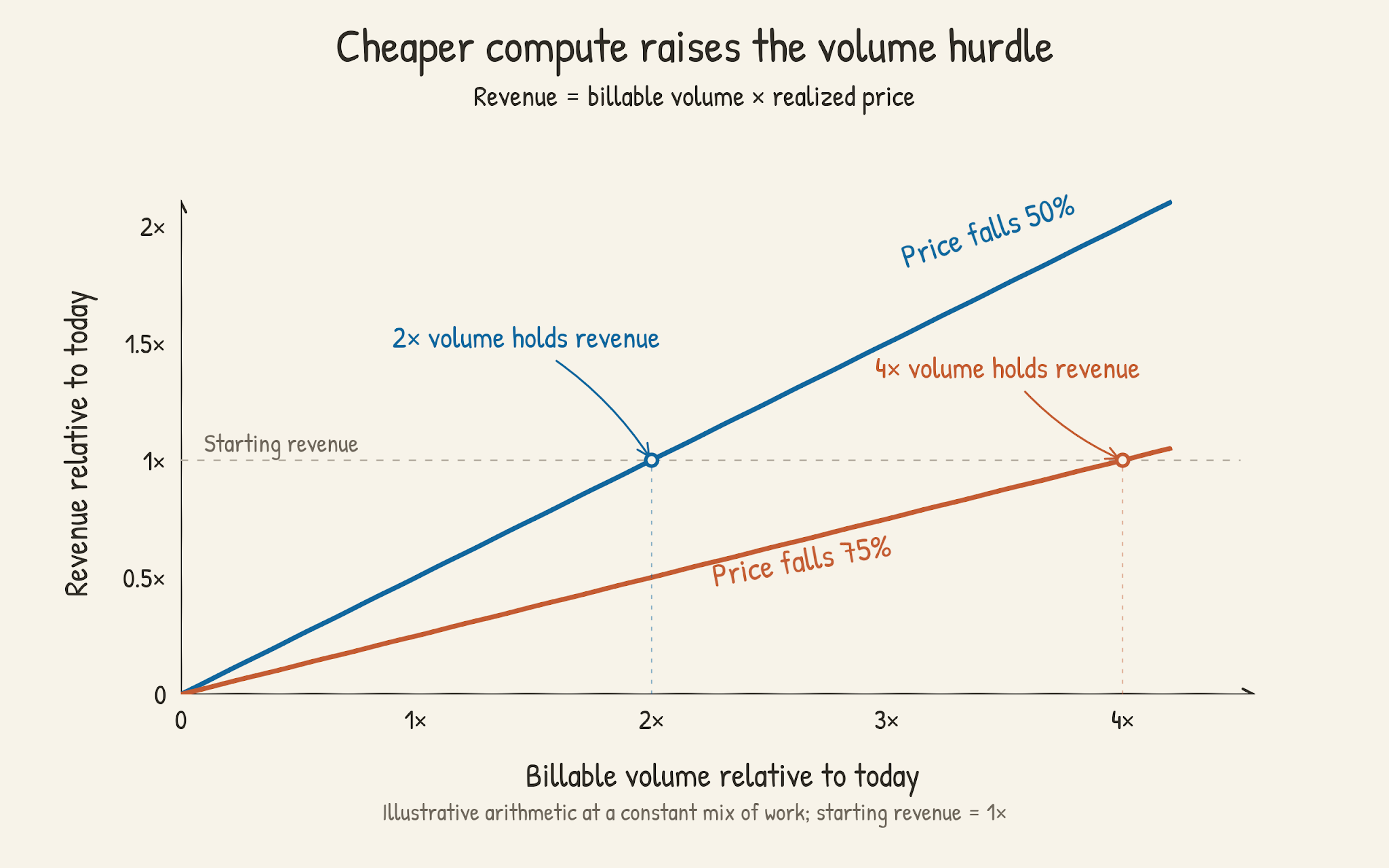
At half the realized price, twice the billable volume is required to hold revenue steady.
OpenRouter's September 22, 2026 newsletter reported that, across its measured traffic excluding reseller activity, open-weight models had remained above 62% of token volume since early July, while closed-weight models captured 73% of spending in the second week of September. Within that marketplace, the proprietary models retained most of the revenue even as available alternatives handled most of the tokens. For the personal assistant app in our example, open weights give its developers the option to run an appropriate model through a chosen infrastructure provider and adapt it to their workload. The premium supplier's future share of spending depends on the additional value its model contributes as that alternative improves.
I would examine that value using the difficult requests the app continues sending to the premium model, asking whether a stronger model that resolves a scheduling problem successfully on the first attempt saves enough retries and user intervention to justify a higher price. The cost comparison needs to include the work required to reach a satisfactory result, since architecture, context length, batching and response speed affect the resources consumed by inference. Microsoft's 2025 Eureka study also found substantial variation in token use between models reaching similar accuracy on its tested tasks. A developer measuring the full interaction can therefore favor a model with a higher quoted token price when it completes the customer's work more efficiently.
The frontier provider can improve the economics of this account as the app sends it more demanding work, earning a higher average amount per successful task when its capability reduces the developer's total cost of delivering that task. The relationship becomes more valuable when a new model allows the app to offer something users previously had to do themselves, such as working through a complicated change across several conversations and calendar entries. The return on developing the next model depends on customers adopting those capabilities and continuing to pay for them as competing models improve, with enough contribution left to fund the next development cycle.
The app's developers can make another purchasing change when part of the work moves onto the user's device. Apple opened its on-device language model to developers through the Foundation Models framework in 2025, including offline use and access without a per-inference charge, while Google's Gemma 3n offered versions described as operating with as little as two or three gigabytes of memory. For our example personal assistant app, a feature that organizes cached messages or prepares a short summary locally can use computing capacity already present on the phone. The developer still pays to build and maintain the feature, and the device supplies the memory, processing and energy, while the recurring API charge for that interaction disappears.
I think this creates an opportunity to make intelligence part of small interactions that users would rarely purchase as separate services. The app could prepare a brief account of a conversation before the user opens it, suggest a reply based on information already on the device, or organize notes as they are created. Each improvement can increase the usefulness of the subscription even when its individual value would be difficult to price. As those features accumulate, the customer can rely more heavily on AI while a growing share of the experience is financed through the app subscription and the hardware purchase, giving the companies controlling those relationships an opportunity to retain more of the resulting value.
The developer can then organize the product around the capabilities available in each place, with routine interactions running locally, other requests using an inexpensive hosted model, and work requiring greater resources going to a premium cloud service. Apple's June 2026 model architecture follows a similar allocation, combining local and server models and assigning complex reasoning and agentic tool use to its most capable cloud offering. For our example personal assistant app, that flexibility allows the team to revisit its supplier choices whenever devices or models improve, while users continue working through the same interface. An investor in the app and an investor in its model supplier are consequently underwriting different claims on the same growth in user activity.
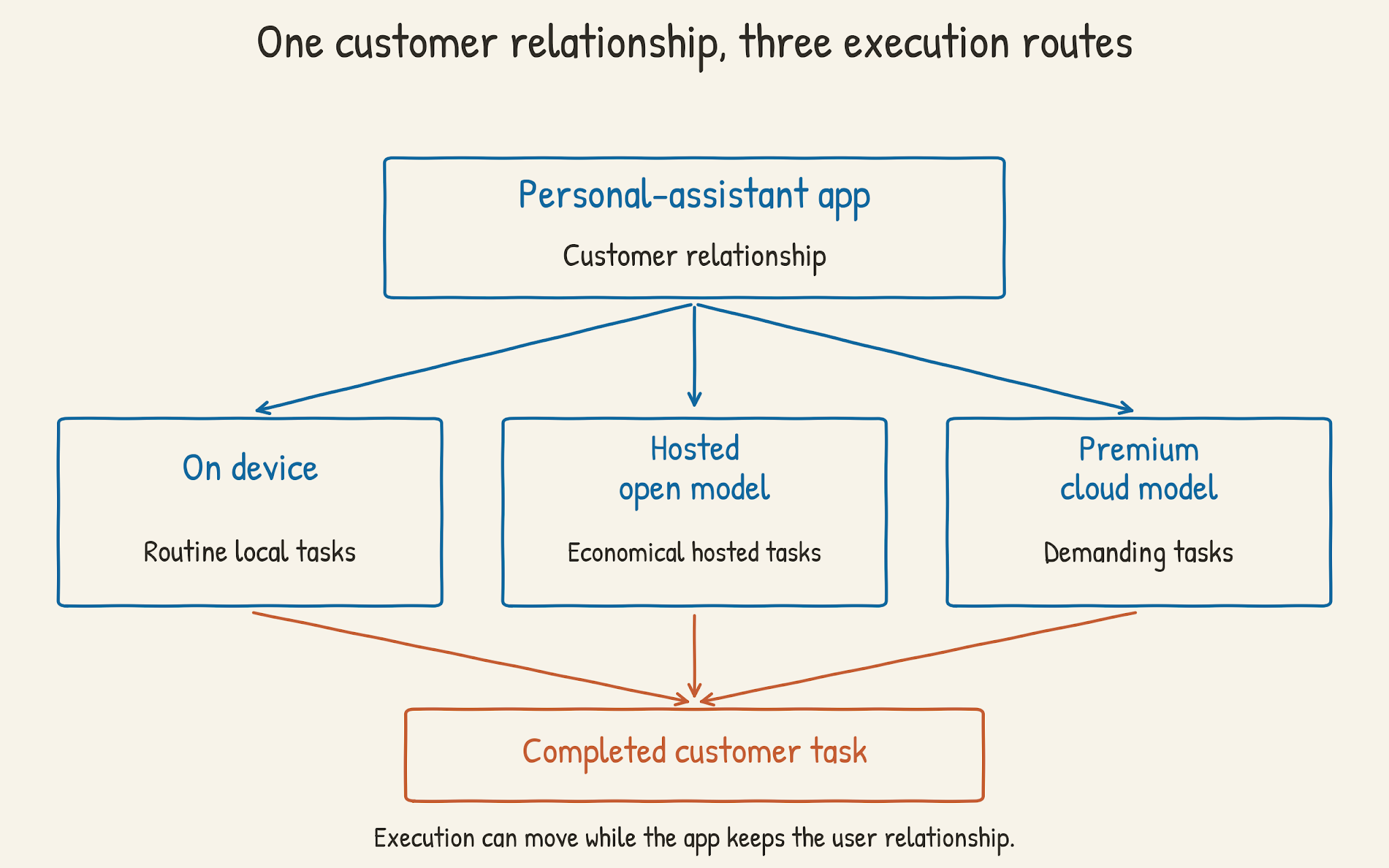
The same customer relationship can route work across local, open-model and premium-cloud execution.
I would expect the frontier provider to respond by moving closer to the work the customer wants completed, particularly if selling raw access leaves too much of the commercial relationship with intermediaries. Outcome pricing becomes compelling when the provider can reliably deliver and measure a result, absorb the resources consumed in getting there, and charge an amount the customer considers worthwhile. If our app pays for successfully resolving a demanding request, a reduction in retries can improve the supplier's margin while leaving the charge unchanged. The supplier also assumes the cost of failed attempts, making its ability to control the workflow and verify completion central to the economics of that offer.
Anthropic's October 26, 2026 S-1 reported $16.3 billion of revenue in the first half of 2026, a $693 million operating loss over that period, and $974 million of operating income in the second quarter, while describing the greater compute intensity of agentic offerings and the challenge of pricing that work adequately. In evaluating a business at that scale, I would want to understand how much of the operating progress comes from serving existing tasks more efficiently and how much comes from customers paying for more valuable capabilities. The answer affects the return on the next capacity commitment: growth in resource consumption creates value for shareholders when the revenue and contribution earned from it justify the additional investment.
Standardized computing can also support attractive returns when a company develops a cost advantage or builds services that become useful together. AWS generated $128.7 billion in revenue and $45.6 billion in segment operating income in 2025 through a business spanning compute, storage, databases and other services. For a frontier-model company, I would examine how its product strategy develops a similarly durable customer relationship as basic capabilities become more widely available. Our app might willingly concentrate spending with a supplier that makes difficult work easier to build and operate, provided the benefit continues to outweigh the savings available from combining alternatives. That gives the supplier a commercial reason to improve the surrounding product alongside the model.
For accounts like our examplel app, I would ask how spending changes as usage expands, which tasks move to other models or onto devices, and what new work customers entrust to the premium service. I would connect those changes to contribution dollars after delivery and support costs, then examine the engineering and capacity investment required to maintain the relationship. An account can remain active for years while its spending shifts toward other providers, so understanding the tasks won and lost gives the revenue forecast a firmer basis than the continued presence of the customer's name in a retention report.
I expect cheaper intelligence to support a much larger market, and I would allocate capital according to the work each company can retain as customers gain more choices about where that work runs (I suspect capital markets will likely play out this scenario). In our app example, the strongest investment could be the supplier whose next model unlocks enough valuable tasks to expand its contribution, or the product company that combines increasingly affordable capabilities into a service users depend on. Both have to keep earning the customer relationship through falling prices and improving alternatives, so the valuation should reflect the cash each can retain after making the investments required to do that, with the forecast following the customer's actual purchasing choices.