Most decisions your leaders are making are reversible or can be broken into smaller problems.
When a VP or Director that reports to you needs several meetings and your approval to test a change that can be reversed within a week, your organization is teaching people to escalate decisions they could reasonably own. Asking that leader to move faster will have limited effect while the approval process remains intact. For those of us in the C-suite, adopting Amazon’s two-way door framework means changing the authority we give our VPs and Directors, along with our expectations of how they use it.
In his 2015 shareholder letter, Jeff Bezos distinguished consequential decisions that are irreversible or nearly irreversible from those that can be changed or reversed. The former are one-way doors that deserve careful deliberation, while the latter are two-way doors that individuals or small groups with strong judgment should move through quickly. His concern was that growing organizations apply the heavier process to both, slowing experimentation as decisions accumulate additional reviews.
For unfamiliar problems, I believe leaders should expect their first decision to need correction as they learn more, even when the original choice reflects sound judgment. Acting within reversible limits lets the team discover which assumptions hold up and use that evidence to improve the next decision. Shortening the time between acting, learning, and making a justified adjustment can help the team become directionally right sooner than prolonged analysis before the first move.
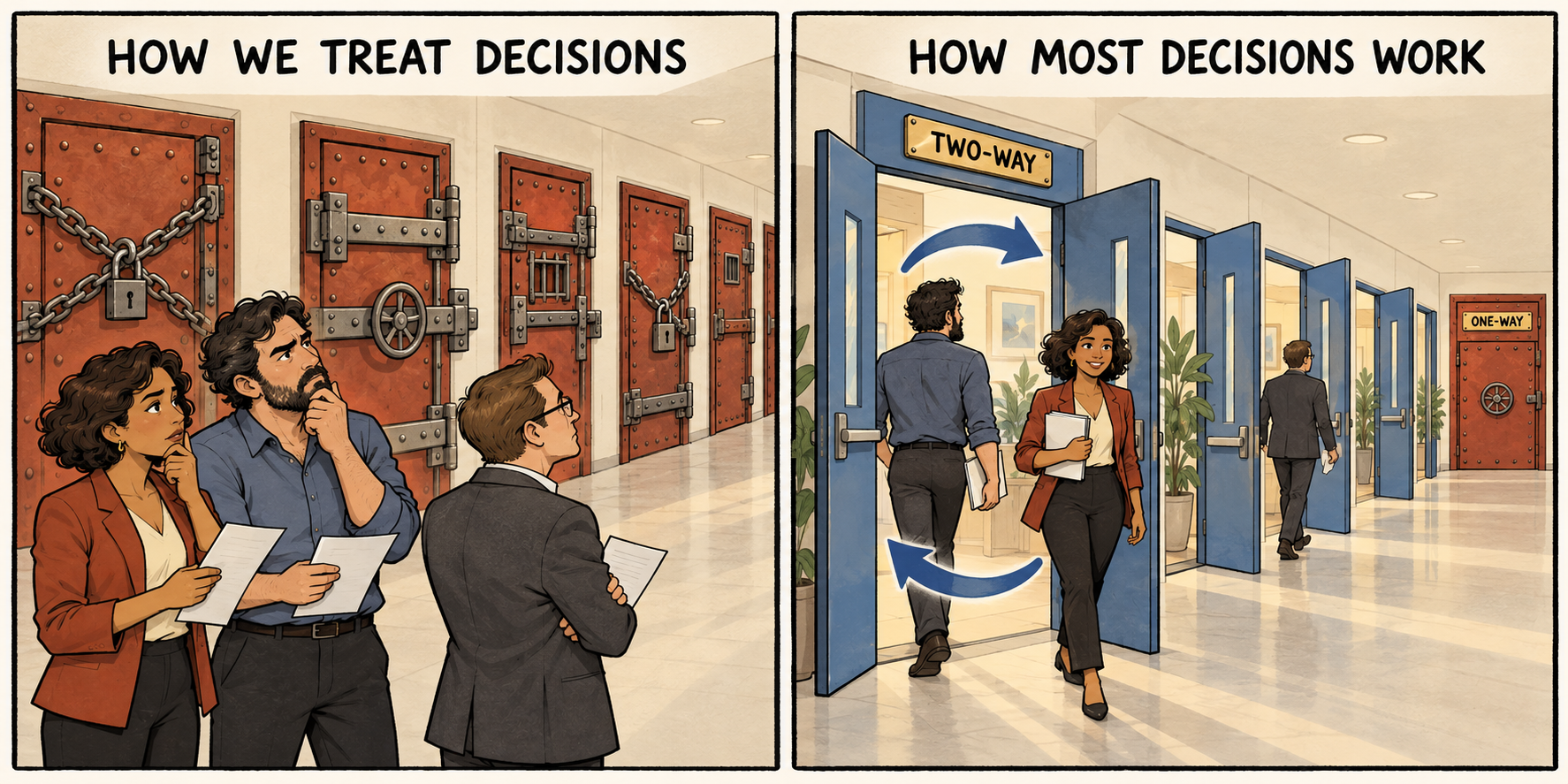
A VP describing a proposal as a two-way door should therefore be able to explain how the team would restore the previous position, how long that would take, and what consequences would remain. Switching off a feature cannot retrieve customer information already exposed or undo a commitment already made. Amazon’s engineering guidance describes preparing for and testing software rollbacks before deployment, reflecting the need to establish that reversal will work under real conditions.
You can develop that judgment with your direct reports by reviewing decisions that recently reached your desk. Working through actual examples reveals where a leader sees consequences you have overlooked, or where an approval exists largely because nobody has questioned it. The discussion should end with agreement on categories of decisions that the VP or Director can make independently, including the limits that would require escalation. Those limits need to cover customer impact and dependencies on other teams as well as spending.
Consider a Director testing a different onboarding sequence with a small group of customers while preserving existing commitments and the ability to restore the established process. If the trial reveals that customers are getting stuck at a different handoff than expected, the Director should be able to revise that step as evidence emerges. Each adjustment can improve the team’s understanding before it commits to a broader rollout, although a company-wide change affecting contracts or requiring substantial retraining would still need a separate assessment.
For a new experiment within agreed limits, a short written explanation can make the reasoning visible without creating another approval requirement. The owner should describe the expected customer outcome and the assumption being tested, including what evidence would justify changing the approach. Agreeing on conditions for stopping or expanding the trial makes adaptation part of the original plan, with an owner who has the authority and resources to act when those conditions arise.
Bezos connected these ideas in his 2016 shareholder letter, suggesting that most decisions should be made with around 70% of the information one would ideally want while emphasizing the need to recognize and correct poor decisions quickly. Your leaders should understand which uncertainties require more investigation before acting and which can be resolved through a limited trial, then allow enough time for useful evidence to emerge. Changing direction with every fluctuation can interrupt learning just as surely as refusing to reconsider an assumption that the evidence has undermined.
Colleagues whose work may be affected also need to understand who owns the decision and how they can contribute to it. A Director cannot exercise meaningful authority if every stakeholder assumes they retain an indefinite veto, although ownership still requires considering other teams’ capacity and obligations. Agreeing in advance on consultation and escalation helps preserve that balance. Bezos’s 2016 letter recommends prompt escalation when teams have genuinely conflicting objectives, because those disagreements require a senior leadership choice.
Some of the hardest work will involve our own willingness to support decisions we would have made differently. Bezos explicitly applied “disagree and commit” to the boss, describing his support for an Amazon Studios project despite his reservations. When a VP has considered your concerns and remains within their authority, requiring them to adopt your preferred option teaches them that delegation is conditional on agreement. Supporting their choice also means being willing to revise your own view when the results challenge it.
That expectation needs to extend through your direct reports into the broader organization, because a VP who receives authority but requires every Director to seek permission has simply moved the queue down one level. Each leader should be able to explain which decisions their teams own and how employees will learn to exercise that judgment. AWS’s operational guidance recommends clear ownership, documented permissions, and opportunities to practice, helping make delegation usable for people accustomed to seeking approval.
Your WBR, MBR, and QBR cadence can reinforce this behavior by examining selected decisions and their results without making the next review a prerequisite for action. Alongside customer outcomes, examine how much time passed between receiving consequential new information and making an appropriate adjustment. That discussion should reveal whether the team was waiting for approval, struggling to interpret the evidence, or continuing to defend an outdated assumption. The number of changes alone says little about whether the team is improving its direction.
How we respond when an initial decision disappoints will determine whether leaders remain willing to use this authority. A VP who makes a reasonable choice within agreed limits, learns why it is underperforming, and adjusts promptly may be demonstrating the judgment we want to develop. Automatically reclaiming authority after that first miss encourages others to protect themselves through additional approvals, while overlooking a refusal to act on contrary evidence rewards the wrong behavior. Accountability needs to include both the outcome and how effectively the leader responds as the facts change.
When the next reversible decision reaches your desk, use the discussion to establish who can act and how the team will know whether its reasoning holds up. Giving your leaders room to make an imperfect first choice, together with the responsibility to improve it, can shorten the time it takes the organization to find a sound direction. As that capability develops, fewer adjustments need to wait for the C-suite, leaving us more time for the commitments whose consequences are genuinely difficult to reverse.