Enduring customer needs should guide investment choices you make as a C-suite leader and connect the work you fund to the results customers experience.
As a C-suite leader, when your leadership team that reports to you (VPs / SVPs) weighs a new platform against additional service capacity, the financial models may look equally persuasive even though they rely on different assumptions about what customers will value and how your business will earn a return. By grounding that discussion in a few enduring customer needs, you can give those proposals a common basis for comparison, so each investment has to explain how it improves an outcome customers are likely to value through changes in technology and market conditions.
A preference for lower prices is a useful place to start, provided you are clear about what the customer is buying and which costs matter to them. For an industrial buyer, a more expensive piece of equipment may still be the better choice if it requires less maintenance and keeps production running, just as a software buyer may accept a higher subscription price when the product reduces the labor needed to complete a workflow. Caterpillar's life-cycle costing guidance reflects this logic, and it points to a more useful principle for these customers: obtaining a dependable outcome at a lower total cost over the period they expect to use the product.
Discovering the equivalent principle in your own industry begins with understanding why customers made particular decisions, which means looking at purchases and renewals alongside the accounts you lost and the alternatives those buyers chose. Working through that evidence with your leadership team, you can trace what prompted the purchase, what the customer hoped to accomplish, and which tradeoffs they accepted, then check those explanations against what happens when the product or service is actually used. In a business selling to organizations, that usually requires conversations with both the budget holder and the people doing the work, because delays and workarounds that matter to users may barely surface in a procurement discussion.
As the same need appears across independent decisions, through different economic conditions and generations of products, you have a stronger basis for treating it as enduring within that customer segment; the customers who behave differently help establish where the principle stops being useful. A buyer who consistently accepts slower service may be revealing a lower willingness to pay for speed, which should affect both the market you intend to serve and the service promise you are prepared to make. Recording those boundaries and testing uncertain preferences through credible offers or small pilots gives the principle enough precision to influence decisions without assuming every customer values the same outcome equally.
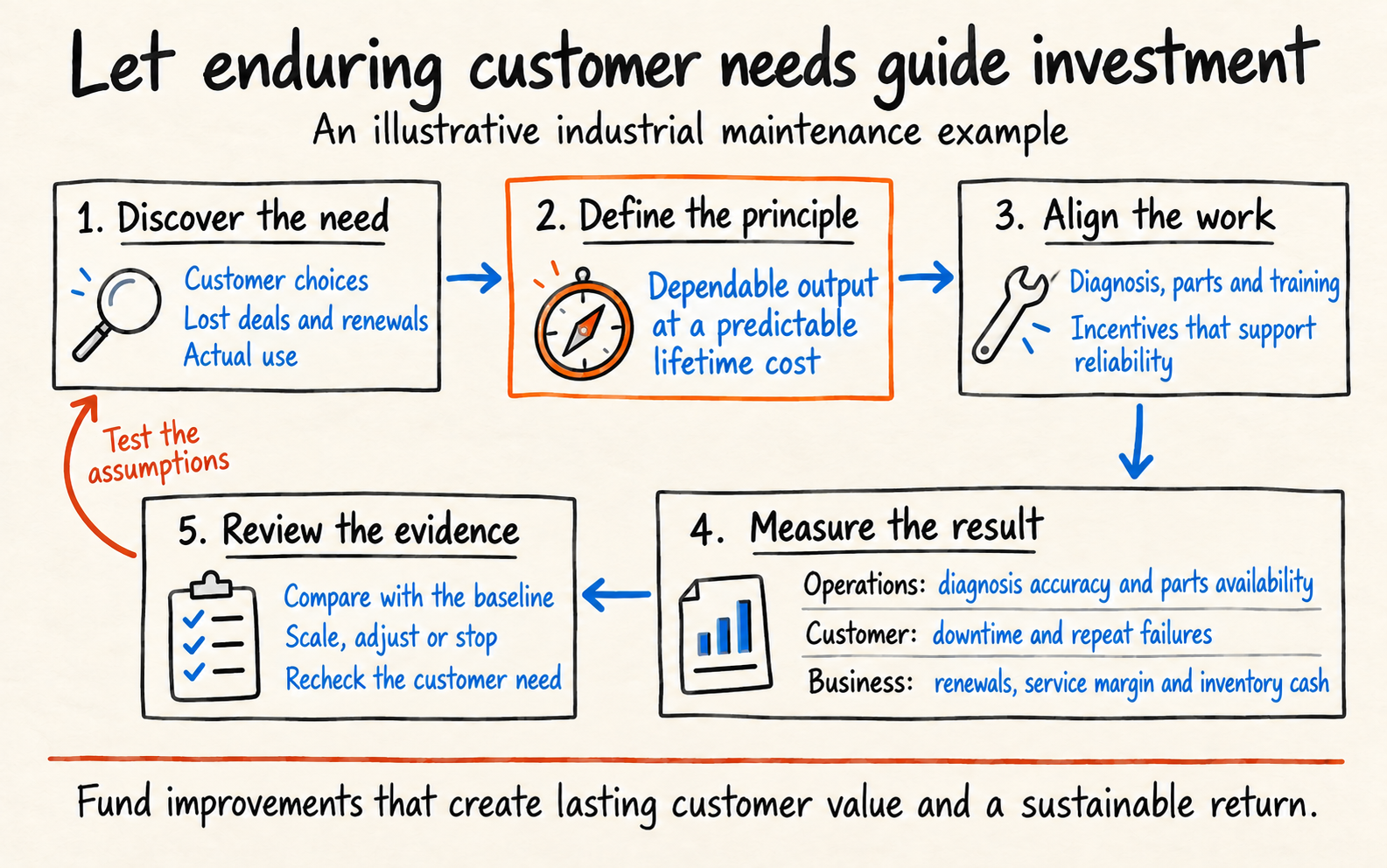
For example, for a hypothetical industrial maintenance company whose customers repeatedly choose suppliers based on their ability to keep equipment running at a predictable lifetime cost, that principle becomes a basis for comparing investments in technician training, spare-parts inventory, and a dispatch platform. If prolonged outages usually follow an incomplete diagnosis or a missing part, a proposal to improve scheduling would need to show how scheduling contributes to the problem before it could justify taking priority over diagnostic training or better parts availability.
You should be able to follow that reasoning through the investment case, from the customer need to the operating change, the improvement the customer is expected to experience, and the return that would justify the resources committed. In this example, better diagnosis could allow technicians to arrive with the right parts and complete a lasting repair on the first visit, reducing repeat callouts and helping the customer resume production sooner; the proposal would then explain who owns that outcome and why this use of resources deserves priority. Where the connection remains uncertain, a defined pilot gives you a way to test the assumption before deciding how much further to invest.
The same reasoning should carry into your operating reviews, where you can compare the work that received time and money with the customer outcome that justified the investment and assess whether the incentives support it. A finance target that cuts spare-parts inventory, for example, may make it harder to restore equipment promptly, while rewarding technicians for completed visits may encourage short appointments followed by repeat callouts. When those measures pull the organization away from the customer promise, the leadership discussion needs to address the conflicting objectives and the measures used to assess executive performance, so the people responsible for delivery have a consistent basis for making tradeoffs.
A practical measurement system follows the investment from the operating conditions you can influence to the result the customer experiences and the commercial return that follows, with a baseline, target, observation period, and accountable owner agreed before work begins. For the maintenance company, that might mean tracking diagnosis accuracy and parts availability alongside unplanned downtime per 1,000 scheduled operating hours, with a potential pilot aiming to reduce downtime from 20 hours to 15 while monitoring whether the repairs last. Renewals, contribution after service costs, and the cash committed to inventory would then show whether the improvement is supporting a viable business, although claims about retention would need to wait for the relevant renewal cycle.
That commercial assessment can uncover a conflict in the business model itself, because a maintenance provider paid for every emergency callout may lose revenue as it becomes better at preventing failures. However, it is incredible risky and ill-advised to take on this mental model as a primary driving force for decisions, as frustrated customers will eventually find a new provider and your reputation for new business will create an unwanted material ceiling. On the flip side, a service agreement that rewards reliable coverage could bring customer value and the provider's economics into closer alignment, provided its pricing reflects the costs and risks assumed; the investment decision therefore needs to account for how the company will earn a sustainable return as customers require fewer interventions.
Those economics should also shape how far you pursue the improvement, since the value of greater reliability depends on what customers need and what it costs to provide, as Google's reliability engineering guidance explains. In the maintenance example, additional inventory may eventually provide too little extra uptime to justify its cost, while faster repairs that compromise safety or lead to repeat failures would defeat the purpose of the work, so the target should sit alongside explicit limits on the costs and risks the business is prepared to accept.
Before treating an improvement as evidence that the investment worked, you also need a comparison that helps distinguish its effects from lighter workloads, newer equipment, or a different customer mix. Where feasible, your team can randomize a pilot across appropriate operating or customer groups; where that is impractical, comparable locations and their prior trends can inform the assessment, provided you acknowledge the limitations of the comparison. Microsoft's experimentation research from 2020 (Patterns of Trustworthy Experimentation: Pre-Experiment Stage) adds a further caution about interpreting early results, because a favorable short-term metric can misrepresent longer-term value, making the observation period part of the decision about whether the evidence is strong enough to justify expansion.
Over time, this approach should make it easier for leaders (VPs / Directors) throughout your business to exercise judgment within their authority, because they can evaluate a proposed action against a shared customer outcome, an agreed spending limit, and the conditions that must hold. A regional manager considering a local parts investment would then have a basis for deciding without repeatedly asking the executive team to reinterpret the strategy, while decision turnaround times and recurring escalations would help you assess whether that clarity is actually reaching the people doing the work.
As you review those decisions over time, you can also test whether the original principle still holds, whether customers' priorities have shifted, and whether another approach could serve them more effectively. For the shared example with the maintenance company, predictable production could remain the objective while the most promising investment moves from repairing failures quickly to preventing them altogether, allowing the organization to change its approach while remaining clear about the customer outcome that justifies the work.