(This article is written for PE Managing Directors & Partners; if that’s not you, feel free to skip this article.)
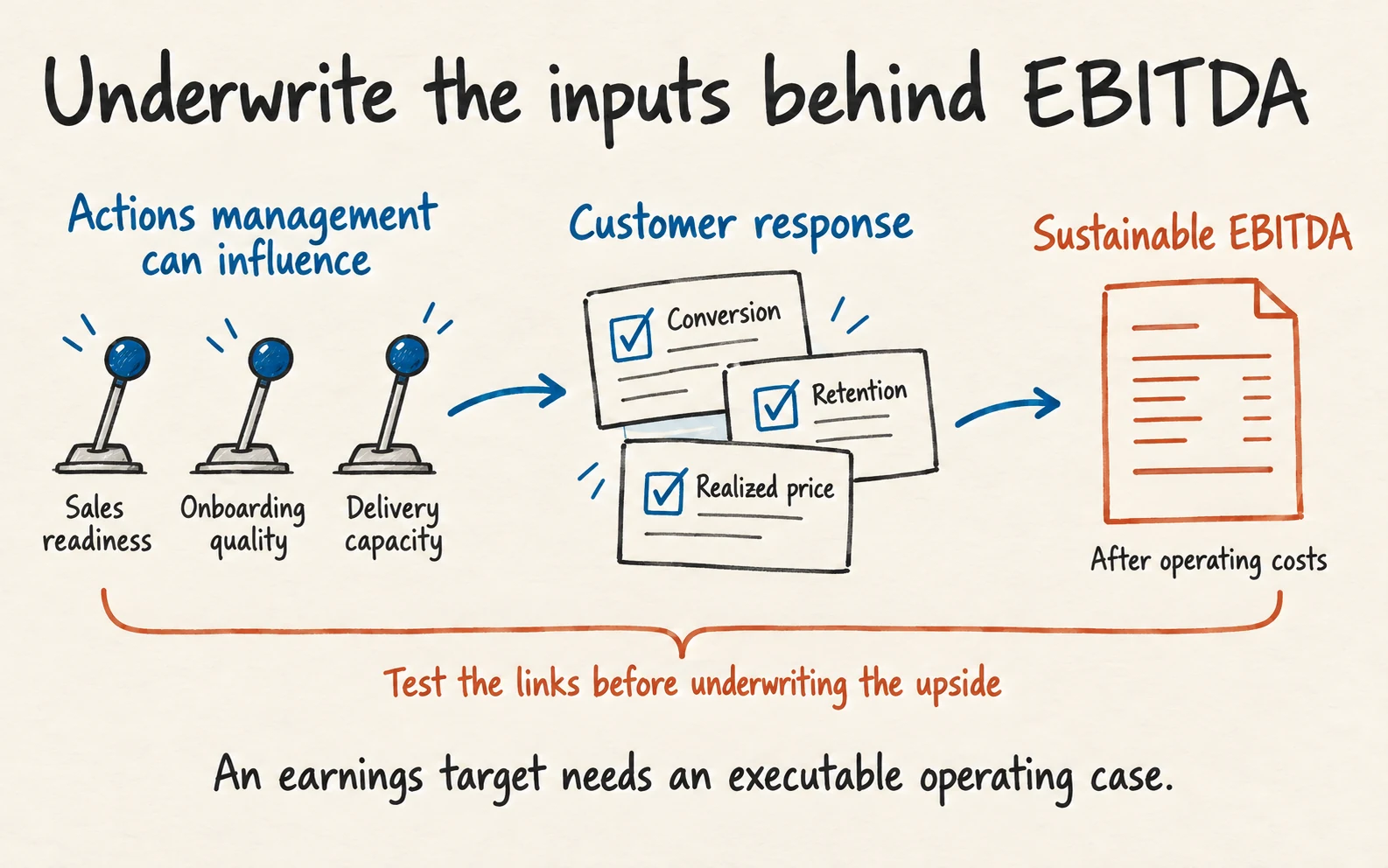
Before paying for projected EBITDA, go a few levels deeper beyond the output metrics of potential acquisition targets and use input KPIs (leading indicators) to establish whether the business can fund and execute the improvements needed to service its debt, sustain growth, and deliver LP returns.
If your investment thesis depends on substantial EBITDA improvement, the operating inputs required to produce that improvement deserve the same scrutiny as the acquisition price and financing terms. Before committing capital, you should be able to explain to your LPs why the management team can deliver the assumed growth, what the business will have to spend to achieve it, and how much room the capital structure leaves for execution to take longer than expected. Those judgments belong in the investment thesis while they can still influence the transaction, particularly when the price already gives the seller credit for improvements you will be responsible for making.
After raising a $250 million LBO fund myself to pursue a services roll-up, I applied this discipline to the investment thesis itself, examining the potential acquisition targets and their input KPIs (aka leading indicators) to determine whether the strategy could support the EBITDA forecasts on which the investment case depended. The businesses would have needed to generate enough cash to service debt, fund operational efficiency improvements, finance the growth plan, and ultimately return capital to our LPs. The operating evidence did not establish a credible path and correlation to meeting those requirements together, and I decided not to proceed with the investment thesis and allowed our access to credit facilities to expire while also canceling our capital calls.
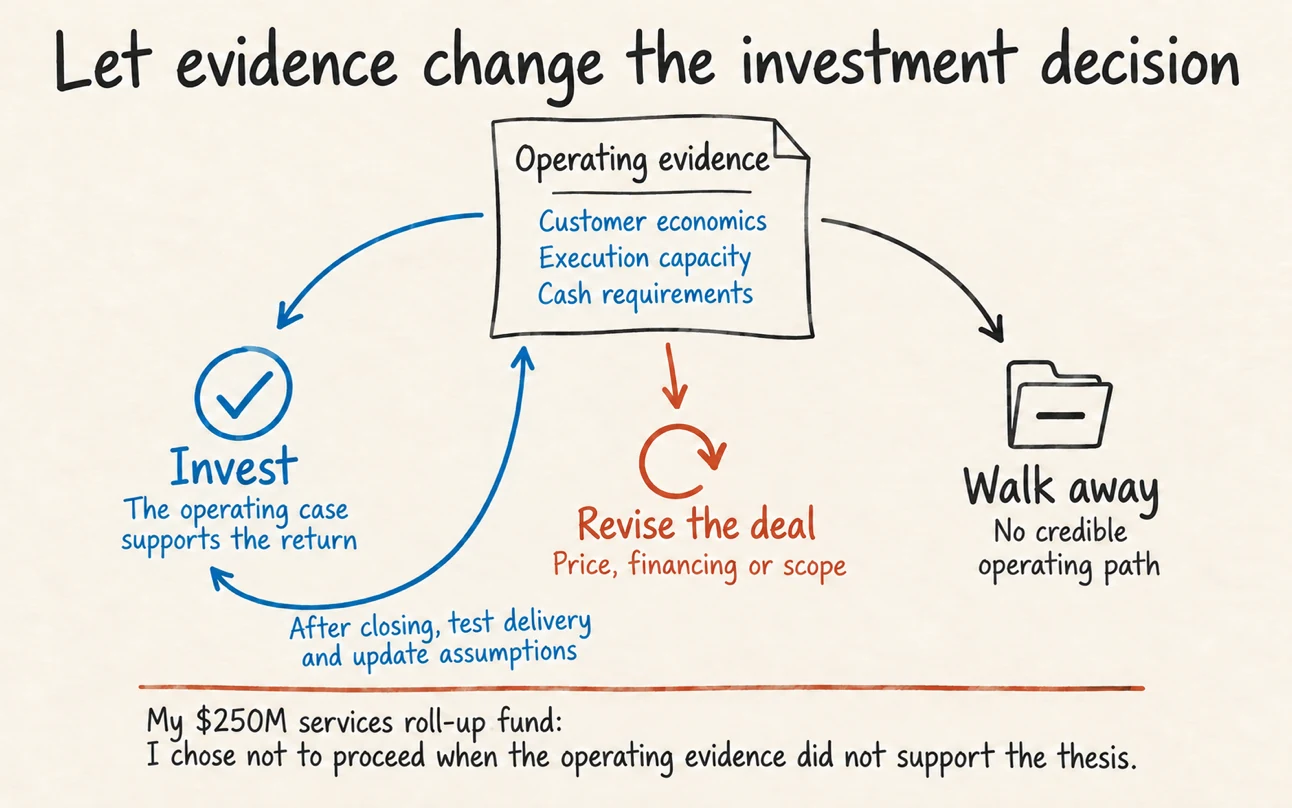
For a services roll-up, the relationship among those obligations is fundamental to whether the thesis is executable. A forecast can show attractive earnings at the end of the holding period while leaving insufficient cash to finance the changes needed along the way; equally, an improvement that appears achievable on its own can become unrealistic when combined with the other demands on the organization. Input KPIs (leading indicators) bring those dependencies into the investment discussion while you can still decide how much improvement belongs in the price and what additional resources the business will need. In my case, having raised the fund did not resolve the underlying operating constraints, and I was unwilling to treat the need for an attractive investment outcome as evidence that those constraints could be overcome.
Working backward from a return requirement remains useful because it establishes the performance the proposed transaction demands. In a hypothetical acquisition requiring EBITDA to increase from $20 million to $40 million over five years, the implied annual growth rate is approximately 14.9%; the harder judgment is whether the company's commercial opportunities, delivery capacity, and investment requirements support that trajectory. An experienced investment team can sensitize the model thoroughly and still leave that question unresolved if its downside case consists mainly of reducing growth assumptions without examining which operating constraints would produce the reduction. The credibility of the forecast rests on the business's ability to perform the required work under the conditions you have assumed.
In a services roll-up, that examination should begin with the commercial and operating assumptions expected to justify assembling the platform. If the thesis depends on expanding sales capacity and improving customer retention, you need a view of the constraints behind each opportunity before assigning them an EBITDA contribution. Additional salespeople create value only to the extent that they can reach qualified demand, become productive within a realistic period, and sell work the company can deliver profitably. Retention improvement requires a credible explanation of why customers leave and what management can change to influence that decision. Treating either opportunity as a percentage adjustment in the model leaves the most consequential underwriting questions open.
Consider a hypothetical services business whose growth plan assumes that new salespeople become productive in three months, although the historical ramp has taken nine. The prospective PortCo's CRO would need to establish what will change in recruitment, account allocation, training, or the sales process to support the shorter period, with evidence from relevant hiring cohorts where it exists. Average productivity across the existing team would be a weak basis for that judgment if experienced representatives benefit from established relationships that new hires cannot reproduce. The investment case should reflect the productivity you can substantiate for the additional capacity, including the cash required before those representatives contribute at the expected level.
Even a well-supported sales expansion can strain the business if implementation is already constraining customer delivery. The COO and CRO would need to reconcile the new-business plan with the capacity required to activate those customers, since an increase in bookings may otherwise lengthen implementation times and put future renewals at risk. In that situation, the next dollar committed to growth may belong in delivery capacity before additional sales hiring. The CFO would then need to incorporate the additional delivery investment and revised revenue timing into the acquisition case, so that you can judge the expansion on the economics the business could actually support.
Applying a discount to management's forecast addresses some optimism, although it offers limited protection when the revised number retains the same unsupported assumptions. Gompers, Kaplan, and Mukharlyamov found an average 20% discount to management's EBITDA projections among the 44 investors who answered that question in their survey. That is a useful reminder that skepticism is already part of the process; but ultimately, the issue is whether the adjustment reflects an informed view of the operation. A lower forecast may still require sales productivity the business has never demonstrated or simultaneous improvements that compete for the same people and funding. Conservatism is more defensible when you can explain which assumptions you have changed and why the remaining plan is achievable.
The retention opportunity can be evaluated within the same operating case. For example, improving revenue retention from 90% to 95% on a $20 million annual revenue cohort would preserve $1,000,000 of revenue, assuming unchanged prices, a fixed cohort, and no expansion revenue. At a 60% incremental contribution margin, the improvement would generate $600,000 before the program's costs, or $400,000 of incremental annual EBITDA after $200,000 of recurring expense and before any one-time implementation expense. Your willingness to include that contribution in the investment case should depend on the proposed intervention's ability to address the causes of attrition and on the resources available to carry it through.
If delayed implementation is contributing to customer losses, the operating plan might assign clear accountability for each launch and require critical onboarding steps to be completed on schedule. Those are actions management can influence, while time to first value, service issues, and subsequent renewal behavior indicate whether the intervention is working. Before underwriting the retention benefit, however, you would need to establish whether faster onboarding actually influences renewal behavior or whether the customers who complete it quickly already have simpler requirements or stronger internal teams. Diligence should establish how much of the relationship is attributable to the process you intend to change, with comparable customer groups and phased implementation helping to test the assumption where feasible.
These measures also have to preserve their meaning when management is under pressure to demonstrate progress. An onboarding completion rate is of little use if the definition changes to accommodate unfinished work, just as higher retention can conceal concessions that undermine the expected contribution. Agreeing on qualification standards, customer cohorts, and the treatment of discounts during diligence gives you and the management team a consistent basis for evaluating subsequent performance. The financial forecast can then respond to changes in the underlying economics, including cases in which the operational milestone has been met but the anticipated earnings have not followed.
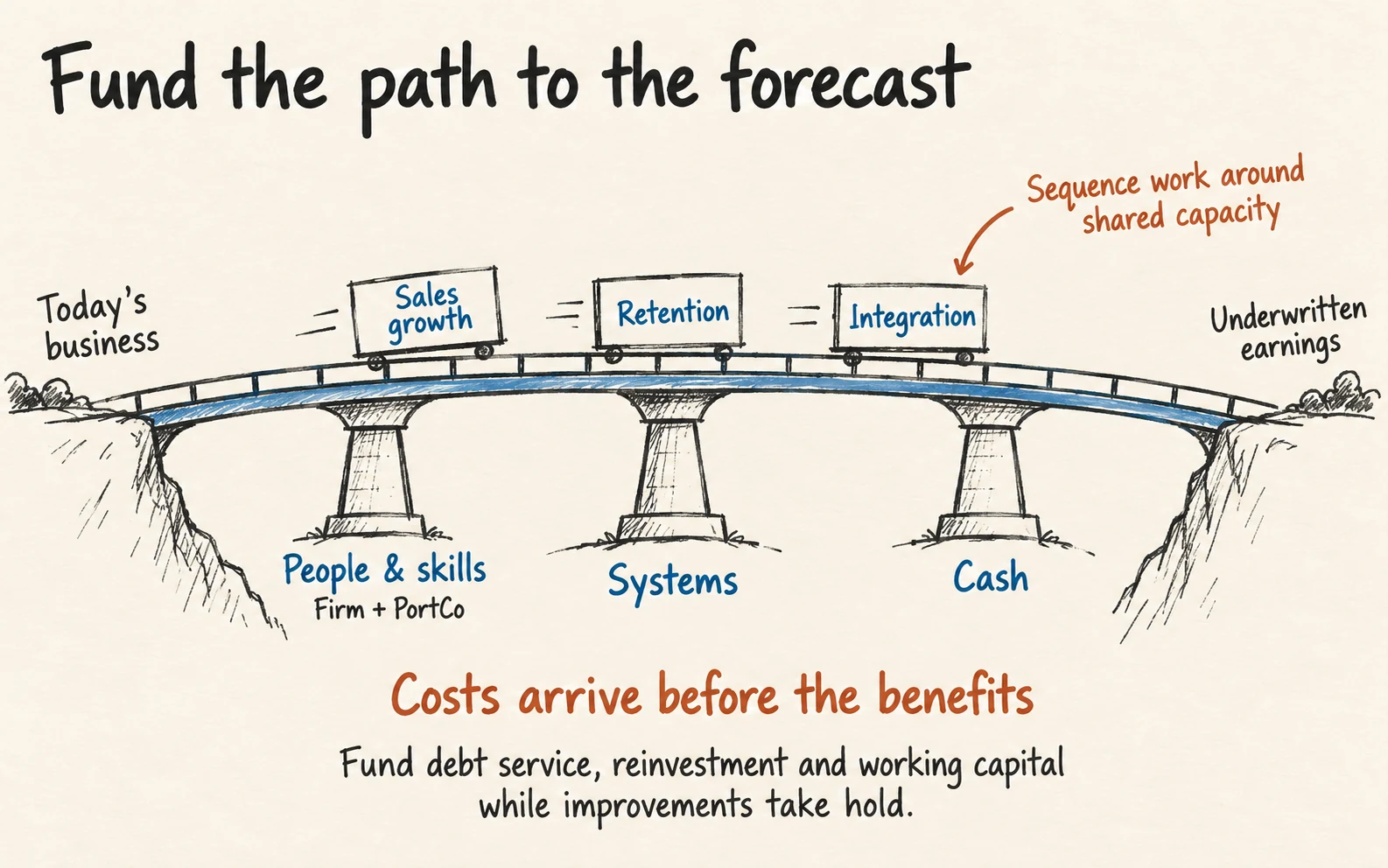
Across the platform, the commercial initiatives will draw on the same organization, with consequences that are easily obscured when each workstream develops its own estimate of EBITDA upside. A pricing program may increase the effort required to retain customers at the same time that sales expansion places additional demands on implementation; if both depend on a technology migration led by a small group of managers, their schedules will also compete with integration work. The PortCo's CEO and functional leaders need to reconcile those demands into a plan the business can fund and execute, with the investment case reflecting what must be deferred and which benefits overlap. A collection of individually plausible initiatives can otherwise support an aggregate forecast that the organization has no capacity to deliver.
S&P Global Ratings' September 2026 summary of its EBITDA-addback research reported that 92% of companies in its historical sample missed first-year earnings forecasts. The sample concerned U.S. speculative-grade issuers and projections presented at deal launch, so the finding should be read in that context rather than as a failure rate for PE investments. When projected savings and synergies support your valuation or debt capacity, the relevant diligence extends to their implementation costs and timing, including whether the organization can absorb the work without compromising the revenue on which the margin improvement depends.
In a manufacturing business, the equivalent constraint may be physical capacity, although the same requirement to connect the intervention to its economics applies. Completing critical maintenance can improve equipment availability and saleable output, but the value of that additional production depends on profitable demand, acceptable scrap levels, and the working capital required to carry inventory and receivables. The operating case has to follow the improvement through those dependencies before you assign it an earnings contribution or assume it will support debt repayment. That is also where sector expertise earns its place in diligence, because the constraint that matters most may sit outside the function in which the proposed improvement originates.
The cash implications become particularly consequential when you are underwriting a business that must finance its own transformation. In the retention example, the recurring $400,000 EBITDA benefit would arrive as customers renewed, while upfront implementation spending could occur well before those renewals. Debt service obligations would continue during the intervening period, and any delay would extend the amount of time the company had to support the program without its expected contribution. Your financing case therefore needs to accommodate the operating sequence, including a plausible period of slower execution, rather than relying on the eventual earnings improvement to justify liquidity the business will need earlier.
When diligence exposes a funding requirement or execution constraint that the proposed transaction cannot accommodate, the response belongs in the investment decision. A lower price, additional resources, or revised financing may preserve an attractive opportunity, while some improvements may warrant staged investment after the operating evidence develops. Where those changes still leave the return dependent on assumptions you cannot defend, proceeding on the original terms means accepting a risk the analysis has already identified.
The risk is easy to underestimate when prior exits have rewarded a weaker operating case. Bain's 2017 report found that more than 2/3 of portfolio companies in a historical subset of its proprietary deal database missed projected margin expansion, while the average realized exit multiple of 10.9 times EBITDA exceeded the underwriting assumption of 8.8 times. Multiple expansion helped compensate for the operating shortfall in that sample. An attractive realized return therefore deserves examination at the level of its underlying sources before you use it to validate the next thesis: the improvements management delivered, the capital required to achieve them, and the contribution from market conditions may tell quite different stories about what you can repeat. I fear however, that these types of beating projected exits on multiplier will be a thing of the past over the next 5 years, as several PortCos are refinancing their debt at 3X their ZIRP rate.
Making this approach work also requires giving operating professionals a meaningful role before the acquisition terms are settled. Simon-Kucher's October 2026 survey of 215 respondents found that 66% believed commercial diligence focused too heavily on market opportunity and too little on management's ability to deliver it. That concern is directly relevant when the people responsible for execution are brought in after the investment team has already priced the improvement. A pricing specialist should be able to challenge the customer economics and implementation assumptions embedded in the case, just as an experienced technology leader should be able to change your assessment of the cost and timing of integration.
You also need that depth of expertise on your own firm's bench, with enough authority to influence underwriting and enough capacity to support the commitments made to management. Assigning an operating partner to a portfolio company does not establish that the specific skills required by the thesis will be available when the work begins. The investment committee should understand which capabilities already exist within the business, what additional expertise you will provide, and how the resulting commitments affect the plan's cost and timing. Management can reasonably be held accountable for execution when the agreed resources and decision authority are consistent with the performance being underwritten.
The evidence on execution reinforces the importance of following those commitments through ownership. In their 2020 working paper, Biesinger, Bircan, and Ljungqvist linked preinvestment plans with subsequent monitoring for 1,580 emerging-market investments across 171 funds and found an association between successful implementation and higher investor returns. The study covered several investment types and did not test whether adopting input KPIs improves performance, which is a useful boundary for the argument: the measures earn their place in your investment process by informing decisions about work that changes the business, and their adoption alone says little about whether that work will succeed.
After closing, your discussions with the PortCo's C-suite should remain connected to those original assumptions, especially when results begin to diverge from expectations. A missed hiring milestone, a completed hiring plan that fails to generate qualified opportunities, and stronger sales activity that produces little incremental profit represent different problems and justify different uses of capital. With the original baseline and measurement definitions intact, you and the management team can establish where the expected relationship has broken down and decide whether further resources are justified, the intervention needs to change, or the earnings expectation should be revised.
The quality of that discussion will depend on how you respond when the evidence challenges the acquisition case. If management is rewarded for preserving the original forecast despite weakening assumptions, the reporting process can become an exercise in defending the transaction, with useful operating signals discounted until they appear in the financial results. Your CEO needs room to acknowledge that an initiative is not working while remaining accountable for the reasoning behind it and the response to new information. That standard should apply to the investment team as well, particularly where management's revised assessment exposes an assumption made during underwriting.
AI makes this discipline more consequential wherever adoption changes both delivery costs and competitive behavior. Your PortCo may meet every milestone in an automation program and still retain less of the projected benefit if competitors introduce similar capabilities and customers expect lower prices or more service. An operating thesis that measures deployment without examining customer response will miss that exposure. The relevant judgment is how much economic value the company can retain as those conditions evolve, with the earnings forecast adjusted when the evidence changes even if the technical implementation has proceeded as planned.
When you reach investment committee, the question is how much of the proposed improvement the operating evidence justifies paying for and whether the business has the capacity and funding to pursue it. You may have compelling reasons to believe the opportunity exists, but the investment still depends on the organization being able to capture enough of it, within the holding period and capital structure, to meet its obligations. If that’s the case, then proceed. However, if there are holes in the analysis or clear risks that do not have a clear path for mitigation based on historical input KPIs, it is best to preserve the capital for another investment or ultimately, an entirely different thesis.