If your org’s front-line individual work is not measured and rewarded against your company’s top line goals, great execution means nothing. Similarly, your departments / functions must make explicit commitments to each other and be rewarded for when those commitments are met for the greater good.
As a C-suite leader, you’ve probably heard hundreds of times on how great execution will always beat great strategy. However, when asked how to put that mental model into practice, most leaders are unable to articulate what that actually means outside of setting a lower number of priorities.
Additionally, a company can run disciplined operating reviews and reward employees for meeting their targets while making little progress toward its growth objectives. That can happen when the goals assigned to functions, teams, and individuals encourage work that looks successful within each department but fails to produce the result the company needs. For a CEO / President or other C-suite leaders, the practical test is whether you can follow a company's priority all the way to an individual’s responsibilities and explain how completing that work contributes to the intended outcomes your organization is pursuing.
Research on group performance supports examining that connection. A 2011 meta-analysis in the Journal of Applied Psychology found positive group-performance effects in a small set of laboratory studies where individual goals emphasized “maximizing the individual contribution to the group’s performance.” The implication for organizational design is worth testing: an employee’s goals should describe a contribution that helps the surrounding work succeed, including the conditions under which colleagues can use what that employee delivers.
Consider a hypothetical software company seeking to increase annual recurring revenue by 15% over twelve months while maintaining its gross margin. Before assigning departmental targets, the leadership team would need to establish how much growth should come from new customers and expansion, how much revenue it expects to lose through cancellations and downgrades, and whether the business has the capacity to serve the resulting customer base. This creates a shared explanation of how the company expects to grow, against which each executive can assess the contribution their function must make.
Suppose that review identifies delayed implementations as a constraint on customers adopting the product and eventually renewing or expanding. Sales would need to commit to customer requirements and delivery promises that the business can fulfill, while implementation would need sufficient capacity to bring those customers into productive use. Product and customer success would have related commitments around product readiness, adoption, and ongoing support, with the leadership team agreeing how those contributions are expected to affect retention and growth.
At team level, the implementation commitment could become a target for customers to complete an agreed production workflow within thirty days of an accepted handoff. The team would need to define that workflow with the customer, establish what successful use looks like, and work backward through the tasks required to reach it. The thirty-day target would then have an operating plan behind it, with named people responsible for data migration, configuration, testing, and customer training.
For the individual contributor handling migration, the resulting commitment might be to import and validate the customer’s data by day ten so configuration and testing can proceed on schedule. Their responsibilities would include confirming the source files, applying the agreed field mappings, checking record counts and required fields, resolving exceptions within their authority, and documenting anything that requires a customer or product decision. Completion would mean that the next person can use the migrated data for the agreed workflow, supported by validation results and acceptance from the person responsible for the next stage.
That definition changes how the individual’s work should be managed and evaluated. A completed import would need to be assessed alongside its accuracy, the rework it creates, and whether it was ready when the next team needed it; an engineer who processes more migrations while leaving colleagues to repair preventable errors would be making a weaker contribution to the team’s objective. Conversely, time spent resolving a recurring mapping problem could deserve recognition when it reduces failures across subsequent implementations, even if that work temporarily lowers the engineer’s individual throughput.
The employee also needs a clear basis for handling dependencies they cannot resolve alone. If customer data arrives late or a product defect blocks validation, their responsibility could include documenting the impact, notifying the relevant owner within an agreed period, and proposing a recovery plan. Their manager would then own the decisions about priorities, additional support, or escalation, while performance evaluation would distinguish the employee’s response from the delay caused by the external dependency. This makes accountability specific enough to be fair and gives the organization an earlier opportunity to protect the customer commitment.
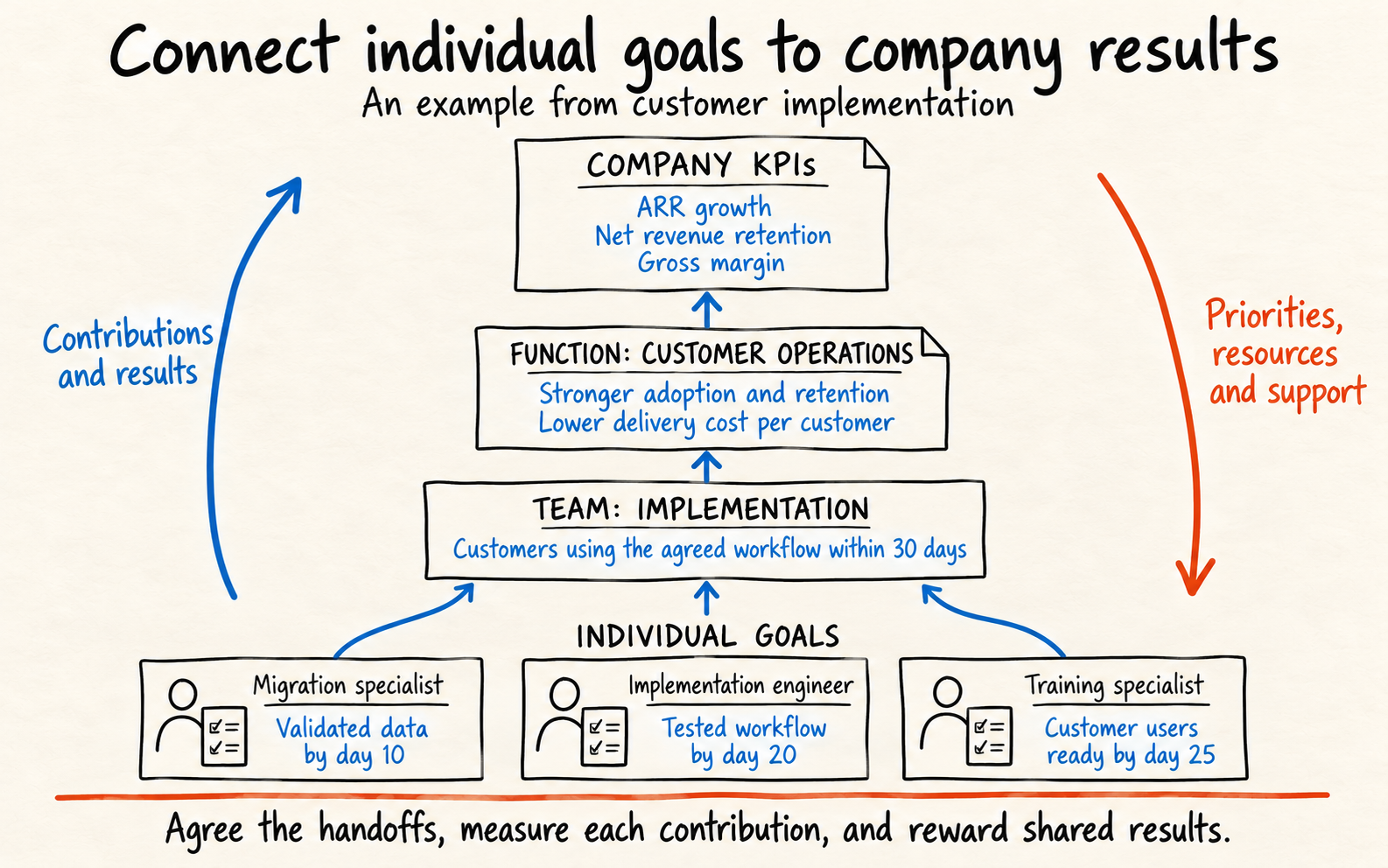
The same clarity is needed where functions hand work to one another. Sales and implementation should agree what constitutes an acceptable handoff, including confirmed scope, customer readiness, promised functionality, and a feasible delivery date. If a commercial opportunity requires an exception, the leaders involved should resolve its implications for capacity, timing, and cost before assigning delivery commitments to the team. Otherwise, the company creates an obligation at the executive level and leaves individual contributors to absorb the consequences through overtime, rushed work, or missed targets.
Performance measures (as monthly, quarter, and annual reviews) and incentives (bonuses and stock grants) should reinforce these responsibilities at the level where people can meaningfully influence them. The migration specialist’s evaluation could cover accepted quality, timeliness, preventable rework, and the handling of dependencies, while the implementation team’s measures would include time to productive customer use and problems discovered after launch. Executive incentives would connect those operating results to company performance and the commitments each leader has made to other functions, giving the CEO a basis for assessing whether departmental achievement is contributing to the commercial plan.
Shared incentives have empirical support, although their design needs to fit the work. In a field experiment published in the American Economic Review in 2017, researchers studying 193 shops and approximately 1,300 employees found that team bonuses increased sales by roughly 3%. For your company, the useful question is how much of a person’s reward should depend on shared results, given their influence over those results and the visibility of their individual contribution; those choices should be established before the performance period begins.
The measures also need to discourage shortcuts that make a target easier to achieve while weakening the customer outcome. A thirty-day implementation target could encourage premature completion reports unless the company also checks that customers can perform the agreed workflow and tracks the problems that emerge afterward. The authors of Goals Gone Wild identified “a narrow focus that neglects non-goal areas” as a potential consequence of goal setting, which is why speed, volume, and cost measures need to be considered alongside the quality of what reaches the customer.
Your operating reviews should follow these relationships closely enough to reveal where progress is breaking down. If migrations are being completed on time and customers are still taking too long to become productive, the discussion should examine what happens between migration, testing, training, and actual use, with the relevant leaders present to make decisions about the constraint. That review also tests the plan itself: if faster implementation produces little improvement in adoption or retention, the leadership team needs to reconsider the assumed contribution to growth and investigate other explanations.
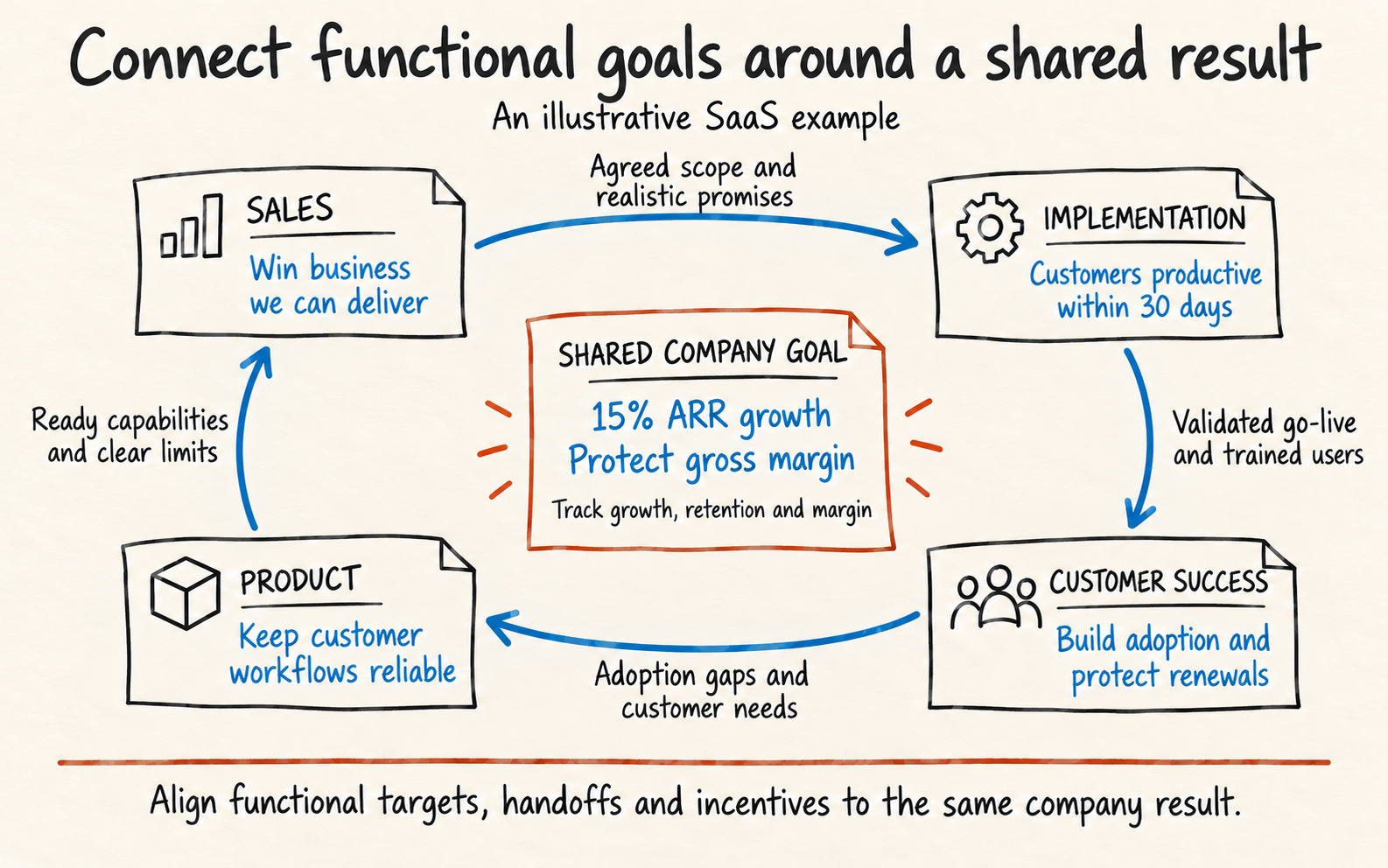
Collective accountability becomes credible when these decisions remain consistent from the executive team to the people doing the work. An individual contributor should be able to explain what they owe, who depends on it, what evidence establishes completion, and how their performance will be judged; their leaders should be able to explain how those commitments combine into the company result. As CEO / President or C-suite leader, you make that connection durable through the priorities you fund, the conflicts you resolve, and the contributions you recognize when people help the wider business succeed.