As contracted capacity becomes operating cash flow, lenders can keep financing the buildout while changing how the risk and returns are shared.
I expect CoreWeave's financing cycle to continue because keeping contracted capacity productive gives creditors a powerful economic reason to keep working on the debt. A lender looking at an approaching maturity can collect through an operating business, refinance into a structure better suited to its cash flows, or pursue recovery through a sale or restructuring. When installed infrastructure is serving paying customers, additional time can increase the amount recovered. As the business moves from equipment purchases and construction into customer delivery, the financing can evolve with it.
The scale of CoreWeave's funding requirement makes that evolution essential. In the first half of 2026, the company generated approximately $3.7 billion from operating activities and used $14.9 billion in investing activities, with total indebtedness of $35.6 billion at June 30. Customer payment timing contributed to operating cash flow, while the buildout consumed capital across successive deployments. The corporate cash deficit brings together assets at very different stages: capacity already earning revenue, equipment being installed, and projects whose spending comes well before customer collections. I would expect creditors to underwrite those stages differently.
That is also how I think about the apparent mismatch between cash generation and financing needs. A growing infrastructure company can be collecting cash from one group of assets while borrowing to build the next. The financing remains workable when each completed deployment earns enough over its competitive life to repay the capital committed to it. Extending a maturity then gives the business time to collect those earnings, while new capital funds another deployment. The problem becomes harder when refinancing must repeatedly cover a shortfall inside the same assets. My attention goes to the cash available after operating costs, necessary reinvestment, and scheduled principal payments within each financed pool.
Financing a cluster before it operates requires a view on equipment delivery, power, networking, commissioning, and the customer's acceptance of the service. Once the cluster is working and payments are arriving, much of that construction uncertainty has been resolved. A creditor can assess operating performance and collections, allowing the asset to appeal to investors with different return requirements. The early lender can be repaid by a later lender that is comfortable with the remaining exposure, and the borrower can negotiate a maturity schedule suited to the revenue now being earned.
Beatrice's offshore wind financing followed that progression. Beatrice reached full operations in May 2019 and refinanced its senior debt that July. Existing lenders stayed involved, new lenders entered, and the facilities were heavily oversubscribed; the owners attributed that appetite to the removal of material construction risks and the project's operating performance. Completion changed what creditors were being asked to finance. The same process can operate in neoclouds as an expensive construction program becomes a functioning service with customers, contracts, and observable cash receipts.
CoreWeave has already negotiated more time on existing credit. Its November 2025 revolver amendment extended the maturity from May 2028 to November 2029 and increased commitments from $1.5 billion to $2.5 billion. For a business deploying capital across overlapping projects, that combination increases flexibility: the larger facility supports near-term funding needs, and the later repayment date gives more deployments time to reach production. These are practical ways for lenders to accommodate growth while retaining a claim on the resulting business. The next refinancing will involve the same negotiation over how much time, liquidity, and protection each party receives.
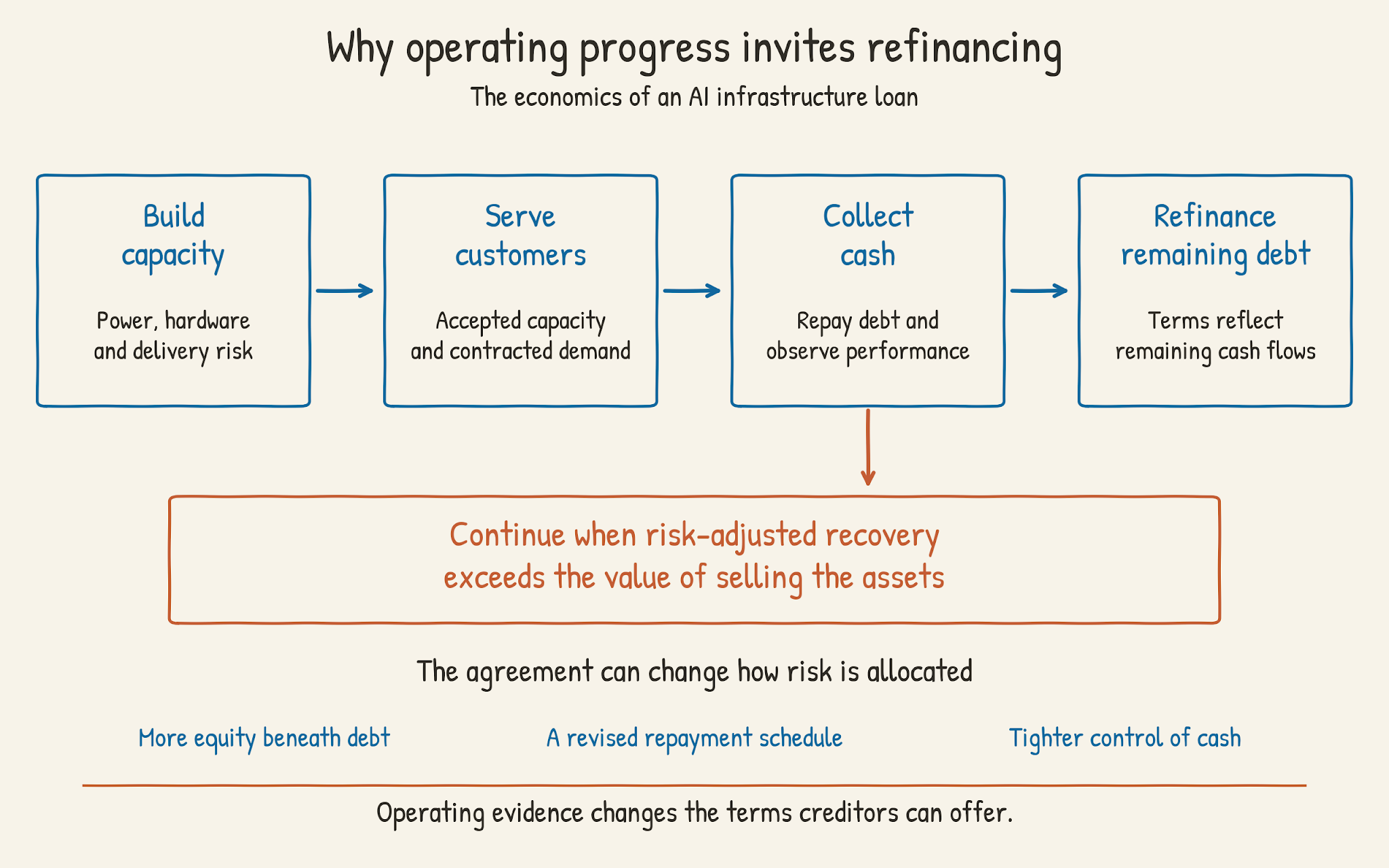
Operating progress can make refinancing attractive when contracted cash flows support repayment.
CoreWeave's March 2026 financing shows how a defined set of infrastructure and customer payments can attract a different price for credit. The facility provided up to $8.5 billion of capacity, with approximately $7.5 billion initially available and further borrowing capacity as assets stabilized. It received investment-grade ratings at the facility level, and its floating-rate tranche was priced at SOFR plus 2.25%. The borrowing subsidiary generally contained the lenders' recourse, subject to limited exceptions. MUFG and Morgan Stanley structured the financing, with Blackstone Credit & Insurance anchoring it. Investors were lending against a particular pool of assets and an associated contract, protected by the structure surrounding them.
The August facility carried a different combination of risks and protections. It provided $2.6 billion with an approximately five-year maturity against customer contracts averaging approximately three years, priced at SOFR plus 5.50%. A full parent guarantee gave lenders recourse beyond the financed equipment. This structure placed a value on the capacity's earning potential after its initial commitments expired, with the parent supporting repayment. I read that willingness to finance renewal exposure as an important development: lenders are learning to price the continuing usefulness of a cluster, including the cash it can earn from a second customer or a renewed contract.
September's completed $4.2 billion convertible-note offering added another type of investor, with a 2.875% coupon and a 2033 maturity. The equity conversion feature supplied potential upside alongside the debt claim, helping CoreWeave raise capital with a lower cash coupon. Taken together, these transactions show how the financing requirement can be divided among investors who want different combinations of income, collateral, maturity, and equity participation. A continuing financing cycle can draw on that variety (and essentially creativity that the capital markets require) as the company and its assets develop, with the terms of each new claim determining how much value remains available to existing investors.
The strongest incentive to extend credit comes from the economics of the existing exposure. A lender should compare the discounted collections available under an extension, less any additional capital and costs required, with the net proceeds of enforcement. Selling equipment can surrender value embedded in a working cluster: its integration, available power, customer relationship, and ability to deliver service immediately. If continued operation preserves enough of that value, a negotiated extension can improve recovery even after the borrower has encountered difficulty. The OCC's refinancing guidance encourages prudent workouts that improve repayment prospects, giving banks an established framework for making this decision. I strongly believe that the core infrastructure surrounding that these neoclouds are providing very much fall under that framework, where the usefulness of the physical structure, the power connectivity / the energy contracts have much longer livelyhoods / shelf-life and as such, much longer depreciation periods than GPUs that run on top of them.
The creditor group also contains several routes through which a financing can be assembled. CoreWeave's $7.5 billion facility announced in 2024 included Blackstone, Magnetar, Coatue, Carlyle, CDPQ, DigitalBridge, and accounts managed by BlackRock. A bank arranging a syndication can earn fees while distributing exposure; a private-credit investor can retain a negotiated loan; an insurer can seek an income stream matched to its obligations. Their interests overlap around a workable transaction, although their preferred maturities and protections differ. That variety gives the company room to replace one source of funding with another as the assets become suitable for a broader investor base.
Existing lenders also possess information that is expensive for a newcomer to reproduce. They have examined the contracts, assessed the equipment, negotiated access to cash flows, and observed whether management delivers on its commitments. When performance supports another financing, that accumulated knowledge can reduce the work required to underwrite it. The relationship then produces interest income, fees, hedging activity, and future transactions. Ordinary lending earns its return through those contractual payments and the amount of capital successfully deployed; a large, recurring infrastructure program can make that business attractive without requiring equity-like returns from each individual loan.
Customer and supplier commitments can strengthen the cash available to support that relationship. NVIDIA's September 2025 agreement, initially valued at $6.3 billion, obligates it to buy eligible residual unsold capacity through April 2032, subject to delivery, service availability, and termination provisions, including specified insolvency events. For a creditor, the useful value sits in the revenue available from capacity that meets those requirements. Maintaining service protects that revenue, while interruptions or a breakdown in the contractual relationship can reduce it. The operational condition of the infrastructure and the financing decision consequently become closely connected.
That pipeline competes with a broad range of credit opportunities. The Federal Reserve's October 23, 2026 release showed more than $14 trillion of bank loans and leases, while Moody's private-credit outlook identified growth opportunities across consumer assets, acquisition financing, and asset-backed lending. The appeal of neoclouds comes from their potential to absorb substantial capital through repeated transactions with identifiable assets and customer payments. A lender with the expertise to structure that exposure can earn attractive business from the buildout, particularly when its underwriting capabilities give it access to transactions other investors find difficult to evaluate.
As exposure accumulates, maintaining that lending capacity requires room for additional investors. Sector concentration and links between private funds and banks were among the vulnerabilities identified by the Financial Stability Board in May 2026. An investor already heavily exposed to the same customers or equipment cycle may want a smaller share of the next deal even when it remains attractive. Syndication, refinancing into a different investor base, and additional equity can accommodate those limits. The ability to redistribute risk is therefore part of what keeps the financing cycle moving, especially as the amounts involved grow beyond the appetite of the original lenders.
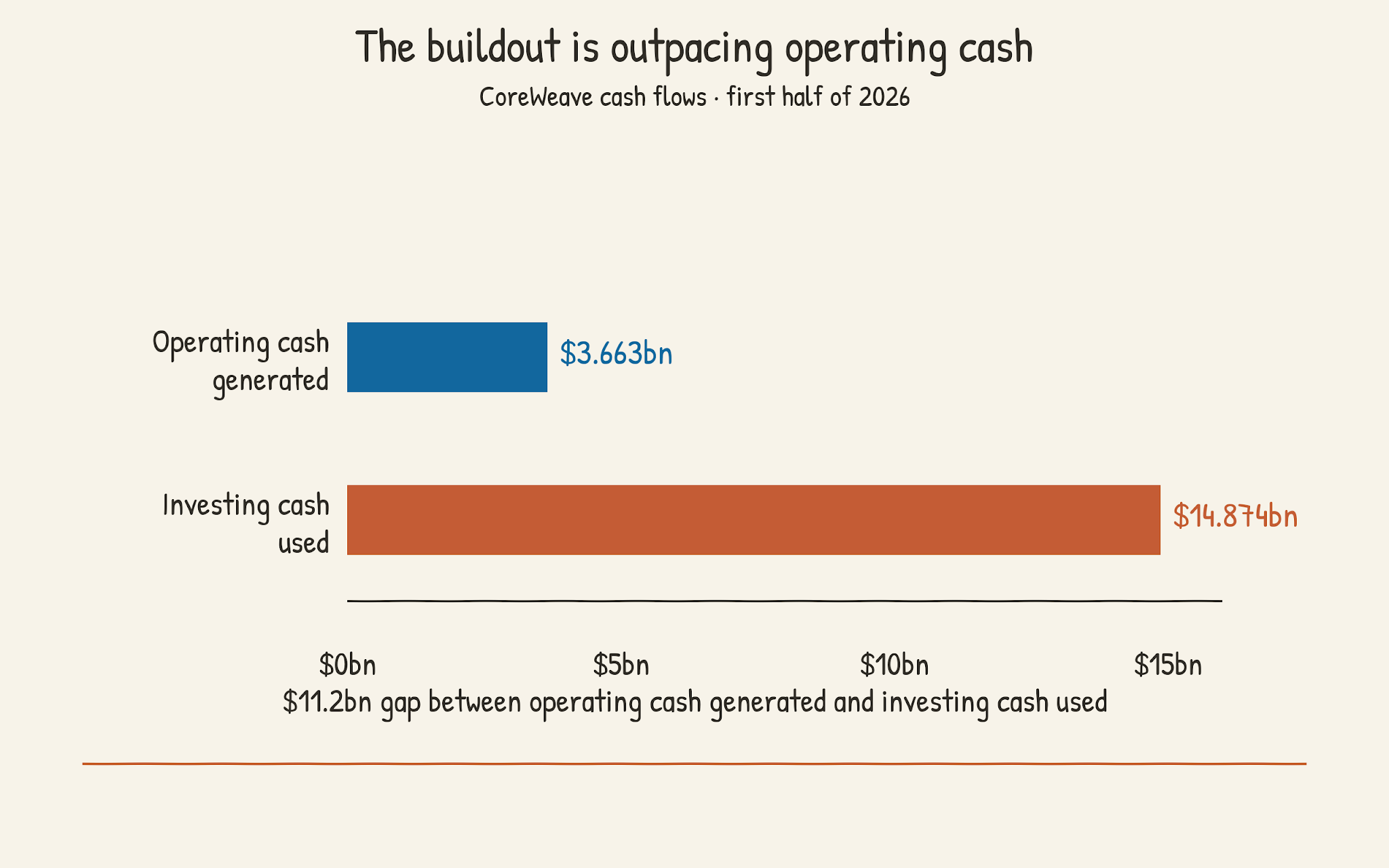
CoreWeave's first-half 2026 cash flows show how quickly investment can outpace cash from capacity already in operation.
The remaining earning life of the equipment determines how much of that risk creditors can carry and how quickly they need to be repaid. New hardware can change the cost of providing a unit of compute and the price customers will accept for older capacity. A cluster may remain useful for years while earning less per hour. Faster principal repayment during the initial contract reduces the debt left to refinance when that pricing change arrives. A lender can accept a lower future rental rate if the remaining balance has fallen sufficiently; a loan that leaves most principal outstanding requires a much stronger renewal outcome. The timing of amortization is central to the durability of the financing.
That lender also has to price the alternative to an extension: selling the GPU fleet when other operators may be trying to sell theirs. Benmelech's research on nineteenth-century railroads linked debt maturity and borrowing capacity to the potential buyers for rolling stock and tracks. Track gauges constrained reuse, and industry distress reduced the pool of buyers. For GPU creditors, the comparable question is what competing operators would pay for the equipment during a broad funding contraction. When several lenders try to sell similar assets at once, weak recovery prices can increase the value of keeping contracted capacity operating and collecting revenue through a negotiated extension.
An extension becomes harder to justify when the equipment's operating cash flow falls faster than the debt can be repaid. Richmond Fed research documented a surge in investment followed by extensive bankruptcies after 2000, as improvements in technology and errors in forecasts produced more capacity than the industry's financial expectations could support. I would apply that lesson to the relationship between compute demand, available supply, and price. Demand can grow rapidly while the revenue earned by a particular generation of equipment deteriorates. Credit should amortize against the cash the assets can collect under competitive prices, allowing the borrower to fund replacement equipment without carrying too much debt from the previous generation.
CoreWeave's customer commitments provide the starting point for that schedule. More than 98% of its 2025 revenue came from committed contracts, and those arrangements typically included customer prepayments. In September 2026, it also reported higher pricing for certain newly signed contracts running approximately three to six months. Long-term commitments establish a base of expected receipts, while shorter contracts give the company opportunities to earn more during periods of scarcity. I would use the committed receipts to support principal repayment and treat additional cash from strong short-term pricing as an opportunity to reduce the balance exposed to the next equipment cycle. I am also of the firm belief that we are in the very early stages of the required AI demand that will be needed in the coming years, as AI in the coming years proliferates into all aspects of our lives, and on a much more dense level, requiring the need for compute and thus the related demand that these neoclouds can potentially absorb. As it stands now, the AI compute supply shortage is already reflected through the need of Agentic reasoning workflows, which start quickly degrading on multi-step outflows, through the high cost paid by customers to run these types of sub-optimal outcome AI workflows.
October's market repricing makes those choices more consequential. Reuters reported on October 16 that some CoreWeave bonds yielded roughly 15% to 16%. Existing fixed coupons continue on their contractual terms, while more expensive replacement financing would consume a larger share of future cash. That changes the negotiation: lenders may require more equity beneath their claims, additional collateral, tighter control of collections, or a slower pace of new construction. If a recapitalization becomes necessary, creditor losses and changes in ownership can preserve an operating business while resetting the claims against it.
I expect lenders to keep pursuing financing solutions because functioning capacity gives them something valuable to preserve, operating progress can expand the range of investors willing to fund it, and there is a dearth in the supply of alternative investments that they could otherwise make that would have the same potential for higher returns vs the aggregated the risk profile in their portfolio. CoreWeave's ability to convert deployments into dependable collections will determine how much time creditors provide and what they demand in exchange. I would track each financed pool from completed capacity to customer payments, principal reduction, and the terms of the next financing. I very much see investments in these neoclouds as asymmetric risk-reward plays for lenders that actually captures the upside of the market as part of their yield enhancement strategy, relative to the rest of their portfolio. That is where the economics of continuing to lend become visible, and where the division of value between creditors and shareholders is decided. However, this is also the reason behind the hype cycle from the uncertainty generated by the derivatives created from these instruments; the hype cycle is then used by certain securities investors to create volatile swings against these instruments (which is where they make their money).