The reasoning your leaders take from a feedback conversation shapes how they handle the next decision and what they teach their own teams.
When a capable executive who reports to you keeps returning to you with decisions you thought you had delegated, consider what they have learned from the feedback you have given them. You may have overturned an earlier choice because it failed to meet an expectation you had never explained, leaving the executive to wonder which other expectations remained unstated. Under those conditions, checking with you becomes a sensible response to the way authority is exercised, even as you ask them to demonstrate greater ownership.
For those of us in the C-suite, feedback therefore carries a responsibility that extends through the layers of management we lead. Our explanations teach people how to resolve competing priorities, while our response to disagreement shows them how openly they can question the assumptions behind our expectations. I think of effective feedback as a decision cycle, connecting reasoning, standard, commitment, timeliness, and evidence. Understanding the reasoning behind a choice allows us to establish the standard that should guide future decisions and agree on how the leader will apply it. Returning to later decisions then gives both people evidence of progress, including whether the expectations themselves need to change as their consequences become clearer. In several of my advisory roles, incongruency around decision making from executives reporting to C-suite leaders was a direct result of those same C-suite leaders giving vague feedback to their VPs / Directors who were their direct / skip-level reports.
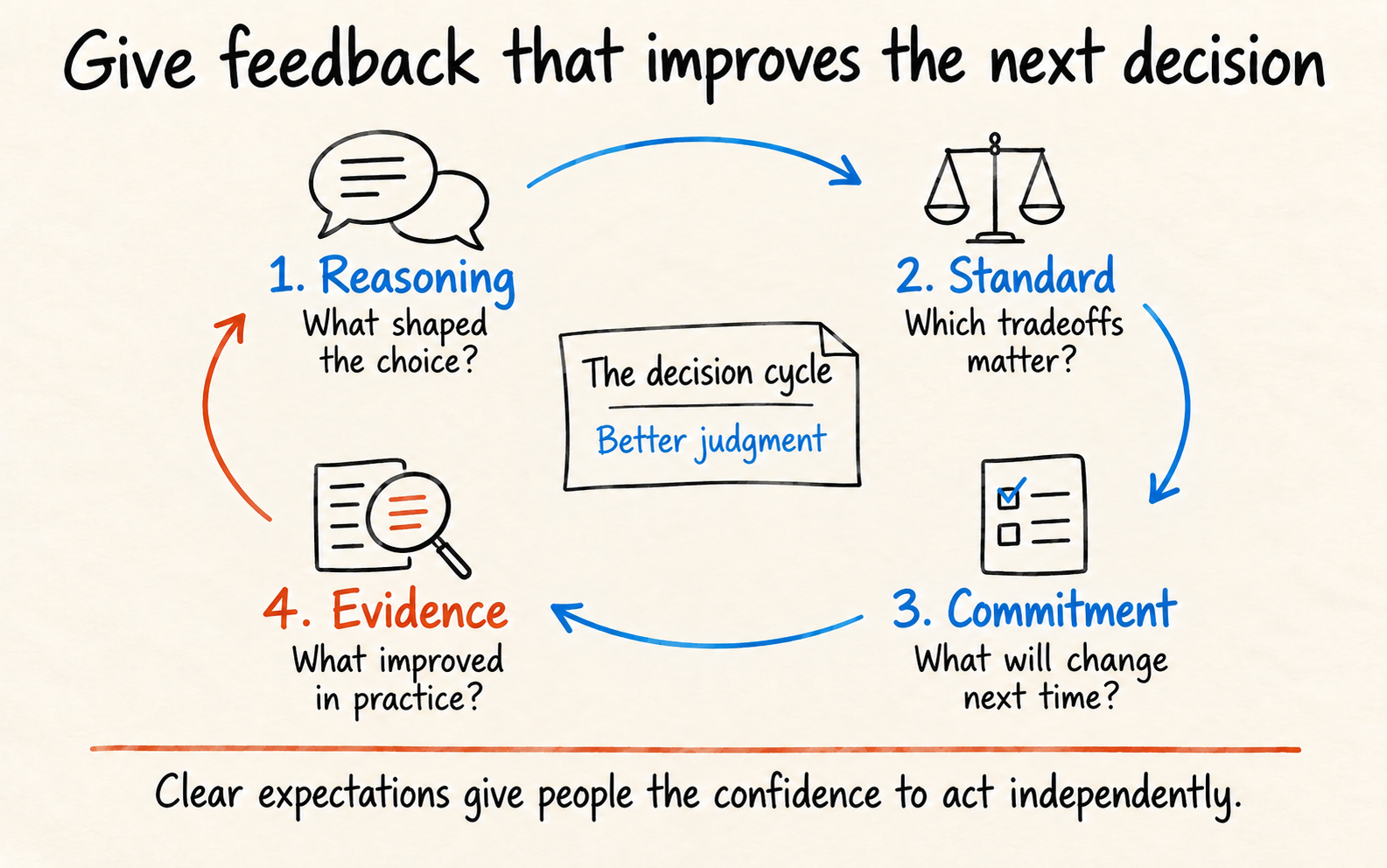
Consider a hypothetical CPO who moves engineers onto a large customer's feature request, delaying a release that several other customers are expecting. The concern you bring as a CEO/President into your next one-on-one should be specific enough for the CPO to understand why you are raising it: the reassignment has put existing commitments at risk, and you believe the consequences warranted a discussion before the work moved. With that concern clear, you can examine what the CPO knew about the customer's situation and how they weighed it against the commitments already made.
The CPO may have been responding to a credible threat that the customer would leave, with your earlier instruction to protect strategic accounts shaping the response. If that instruction left them uncertain about how much delivery disruption you were prepared to accept, the conversation needs to resolve that ambiguity. You may also discover that the commercial risk was more serious than you understood, giving you reason to reconsider your initial assessment while agreeing on how that information should reach you earlier.
Working through the circumstances this way requires candor from both people, which is easier to sustain when the discussion happens privately and close enough to the decision for the details to be examined. An experienced executive should be able to acknowledge an assumption that proved weak without having to defend their standing in front of colleagues, just as you should be able to revise your assessment when they bring relevant evidence. Where the team needs an immediate correction to the plan, explain the revised priorities openly and reserve the discussion of the executive's performance for your one-on-one.
From that examination, you can establish a standard the CPO can carry into future decisions. In this case, that might mean weighing the customer at risk against the commitments affected by moving engineering capacity, with escalation required when helping one customer would break an agreed promise to another. Defining that threshold gives the CPO a basis for handling smaller requests independently and involving you when the consequences require a broader commercial judgment.
The commitment that follows should give the CPO a workable way to apply that standard, which may require you to resolve a problem elsewhere in the organization. If customer promises are scattered across emails and sales notes, for example, asking Product to assess the consequences of moving engineers becomes credible only when you help establish a dependable view of those promises. Following through on your own part of the agreement gives the CPO practical evidence that you want them to succeed and creates a fairer basis for assessing how they handle the next request.
Subsequent one-on-ones give you a way to examine whether this agreement is changing decisions while the details are still fresh. The CPO might raise a similar conflict early enough for Sales to negotiate a narrower commitment with the customer, preserving the wider release plan. Recognizing the reasoning behind that intervention helps the executive understand what to repeat and gives them confidence that early escalation will receive a constructive response. When an outcome disappoints, the same discussion can examine which assumptions failed and whether a different choice was reasonably available at the time. As those conversations accumulate, you both learn where the standard is useful and where it needs refinement.
Suppose you later suggest moving a feature forward because you are concerned about a customer's adoption, and the CPO recommends additional onboarding support to address the same problem. Working through that recommendation gives you an opportunity to support the executive's judgment and show how much discretion the role carries. If you subsequently fault them for failing to follow your preferred sequence, you have taught them that your suggestion carried an instruction, so their next request for permission follows logically from the way you exercised authority.
When a senior leader continues to make the same avoidable mistakes after these expectations and support are in place, the conversation needs to reflect what that pattern means for the role. Preserving the relationship through vague language leaves the executive with an incomplete understanding of their position, especially if you are already questioning their ability to carry the responsibility. Giving them a clear account of that concern, along with the improvement you need to see, allows both of you to deal honestly with the situation while there is still an opportunity to act.
As your executives use the same approach with their own teams, the reasoning behind your standards becomes available to people whose work you will rarely review yourself. A Director can then assess a customer exception against commitments elsewhere in the business and recognize when the consequences require a broader decision. The value of your feedback continues through those choices, giving the organization a more consistent way to act as the distance between your office and the work increases.