Your 1-1 with your VP direct reports should strengthen the judgment and leadership behind business results, giving both people room to address what is helping or hindering the VP’s effectiveness.
If you are a C-suite leader, your 1-1s (one-on-one) with the VPs who report directly to you should strengthen their ability to run the business between reviews. That requires a conversation about how they exercise judgment, develop the leaders beneath them, and work through decisions that affect the wider company. It also requires an honest examination of how your own leadership helps or hinders them, because the authority and priorities you establish influence what they can accomplish.
Suppose you (as a CRO or CEO) and your VP of Sales have just completed a business review covering the revenue shortfall, forecast assumptions, and recovery plan. When the same pipeline report reappears in your 1-1 the following morning, it is easy to spend another hour working through individual deals. You may leave with a better understanding of the pipeline while still knowing very little about why the VP keeps taking over negotiations from their directors, or why they have avoided challenging a product commitment they believe the company cannot deliver.
The same business issue can belong in both meetings, provided each conversation advances a different part of the work. The business review should establish what is happening, what it means for the plan, and who owns the response. The 1-1 gives you room to examine how the VP's decisions and behavior are shaping those outcomes, including the obstacles they need your help to resolve. A missed forecast may require a recovery plan in the review and a candid discussion in private about why the VP withheld doubts they had several weeks earlier.
This distinction keeps the conversation connected to business performance without requiring the VP to present the same information twice. It also makes clear that you need enough knowledge of the underlying business to coach intelligently. If the facts remain uncertain, establish them before attributing the problem to a leadership weakness; if a material risk first surfaces in the 1-1, address it promptly and bring it to the people who need to act.
I would organize the conversation around what is stretching the VP, which decisions require closer examination, where their organization needs stronger leadership, and what they need from you. These four questions give both of you a way to identify the issue that deserves sustained attention. A consequential decision may occupy most of one meeting, while a difficult relationship or development opportunity may deserve the next.
Begin by understanding what the VP is carrying. An experienced executive can arrive with a polished account of performance while feeling increasingly stretched by responsibilities they have been reluctant to discuss. Asking where their attention is going gives them a way to describe that pressure concretely, whether it comes from an inexperienced director, an unresolved disagreement, or commitments that exceed available capacity. Make room for work they are proud of as well, so the conversation helps you understand where their leadership is working and what they want to build on.
A VP who repeatedly steps in for a director may need help setting clearer expectations or deciding what that director can own. A VP whose team lacks capacity may need a priority removed or a commitment renegotiated. Treating both situations as a time-management problem leaves the underlying constraint in place, while taking work away without understanding why it accumulates can deepen the VP's dependence on you.
Candor becomes more likely when the VP sees that acknowledging uncertainty leads to a useful conversation. Amy Edmondson's study of 51 work teams found an association between psychological safety and learning behavior. Applied to this relationship, that finding suggests giving your VPs room to examine a mistake without having to defend their competence at every turn. You can still hold them accountable for understanding what happened and changing their approach; the aim is to make that examination possible while the information can still improve a decision.
The decision itself is often the best place to explore the VP's judgment. Ask them to explain their recommendation before you offer yours, including the alternative they considered and the evidence that would change their view. This helps you see how they weigh competing demands and where additional context could matter. If you begin by announcing your preferred answer, you lose some of that visibility because the rest of the conversation may become an exercise in responding to your position.
Consider a CPO (Chief Product Officer) whose VP of Product is weighing a large customer's request against work that would benefit the broader customer base. The business review may establish the revenue exposure, delivery cost, and recommended allocation of resources. In the 1-1, the CPO can explore how the VP reached that recommendation: whether the customer is receiving disproportionate weight, whether pressure from Sales is distorting the choice, or whether the company has left its priorities too ambiguous for the VP to make a defensible decision. Where the priorities are unclear, the CPO needs to clarify them before treating the recommendation as a failure of judgment.
These conversations become especially valuable when a function's interests pull against the company's. In a Center for Creative Leadership survey, 65 percent of senior executives reported that their leadership team experienced a clash between functional and enterprise accountabilities. That figure describes the surveyed executives, but the underlying tension is directly relevant to a VP's work. A leader can protect a functional target while consuming capacity that another part of the business needs more urgently. Your 1-1 should help them examine that tradeoff before they defend their position in a broader leadership discussion.
Your role in that examination also needs to be clear. Bain's RAPID framework distinguishes the people who recommend, provide input, agree, decide, and implement, which is a useful reminder that offering advice does not automatically make you the decision maker. When the choice sits within the VP's authority, test the reasoning and clarify the constraints while leaving ownership with them. When the decision belongs to you, make it explicitly. An executive who repeatedly sees their decisions taken over may reasonably conclude that bringing a difficult issue to the meeting means surrendering responsibility for it.
Judgment matters just as much in how the VP builds the organization beneath them. A VP of Engineering who resolves every disagreement between two directors may keep projects moving while leaving both directors reliant on personal intervention. In your 1-1, examine what makes those disagreements recur and what the VP has done to address the pattern. Unclear authority calls for a different response from a director who has authority but avoids using it, and both differ from a genuine capability gap. I strongly recommend from my own past personal experiences that you document your 1-1s with you VP directs; the notes from these 1-1 interactions can now be fed through AI to see common recurring patterns around disputes & disconnects if you yourself struggled to connect the dots before. You can also use your 1-1 notes from other direct reports as a collective whole to see recurring patterns that are happening across the org with the help of AI.
The useful outcome is an approach the VP can carry back into the organization. They might clarify which director owns a recurring decision, establish the conditions for escalation, or give feedback they have been postponing. Your follow-up can then examine whether that change helped the directors work more effectively. This connects development to the way the business operates and gives the VP a reason to invest in the capability of their leaders, even when intervening personally would be faster in the moment.
The VP's own development deserves the same specificity. Google's Project Oxygen identifies coaching, empowerment, career development, collaboration, and decision-making among effective management behaviors, all of which remain relevant when the person you manage is already a senior executive. A VP preparing for broader scope might need experience allocating investment across functions or presenting a recommendation to the board. Agree on an assignment that exposes them to the responsibility they need to learn, then use subsequent conversations to examine their reasoning and the feedback they received.
Working across functions brings a further responsibility: helping the VP resolve disagreements with peers without making private access to you the way decisions get settled. When a VP complains about another leader (C-suite, VP or Director), understand what happened and what they have already tried before accepting their interpretation. You may be able to help them prepare for a direct conversation. If conflicting targets or incentives are creating the disagreement, however, the problem also requires attention from the executives who set those expectations. Asking the VPs to collaborate more effectively will achieve little while the organization continues to reward incompatible outcomes.
That is also why a private conversation needs a clear route back into shared decision-making. A VP should be able to acknowledge frustration or test an unfinished thought with you, while decisions affecting another function's commitments involve the relevant leaders through the agreed process. Before the meeting ends, distinguish what can remain private from what others need to know and agree who will communicate it. This preserves the value of individual counsel without leaving colleagues accountable for decisions they had no opportunity to inform. In most situations, I would recommend you always keep in mind that you want your direct reports to be viewed in high regards throughout the organization, and as such, who communicates and what & how it is communicated matters. Your credibility as a C-suite leader is also attached to your direct reports org-wide perception.
The same willingness to examine behavior must extend to your own management. A general invitation for feedback can be easy to sidestep, particularly when you control the VP's scope and performance assessment, given that they are a direct report. A recent event gives the conversation something concrete to work with: a priority you changed without acknowledging the cost, a decision you overrode after delegating it, or an informal suggestion that the team interpreted as an instruction. Asking what your intervention changed for the VP makes it easier to identify a problem you can actually address.
Suppose the VP's team keeps reorganizing work around comments you intended as exploratory. Agreeing how you will distinguish an idea from a decision gives the VP clearer authority to manage priorities and makes you accountable for the consequences of your involvement. Your feedback to them should be equally precise, connecting an observed behavior to its effect and the change you expect. When their preparation improved a difficult leadership discussion, explain why it worked; when they bypassed a peer, address the consequences while the event is still useful to examine.
Supporting this kind of conversation requires a reliable rhythm and modest preparation. For an established VP in a stable role that reports to you, I would recommend you begin with a protected 45-minute meeting every other week and move to weekly conversations during onboarding or significant change. Steven Rogelberg's guidance similarly allows for weekly meetings or longer meetings every other week, adapted to the individual. The recommendation here is a practical starting point, and its usefulness depends on whether both of you can raise issues early enough and give them sufficient attention. Reschedule a canceled meeting promptly so that access remains dependable.
The research supports paying attention to how that time is used. Jonathan Flinchum's 2022 dissertation, based on two surveys of 303 participants, found that meeting quality, particularly the manager's relationship-oriented behavior, was more strongly associated with engagement than frequency, provided meetings occurred at least monthly. A separate study at a Japanese IT company, published online in 2025, found that a conversation script improved satisfaction with 1-1s in a randomized trial. These studies examined engagement and meeting satisfaction rather than VP performance, so they support deliberate conversation design without establishing an optimal executive schedule.
Keep preparation proportionate by using a shared private document that links to existing business material. Ask the VP to identify the one or two issues where your involvement would be most useful, along with their current view and the help they want. Add observations of your own and arrive having read the relevant material, so the VP can spend the meeting exploring the issue instead of reconstructing context. GitLab's public handbook offers a useful precedent for this shared agenda, with most items coming from the direct report. A few considered sentences should be enough to begin. As stated before, I myself have used shared 1-1 logs with my VP directs in which past topics and conversations are captured on an aggregated basis and dated.
For a 45-minute conversation, the following allocation leaves room to understand the VP's situation while concentrating most of the time on an issue that matters. Treat it as a flexible guide, adjusting the balance when a difficult decision or development conversation deserves more attention.
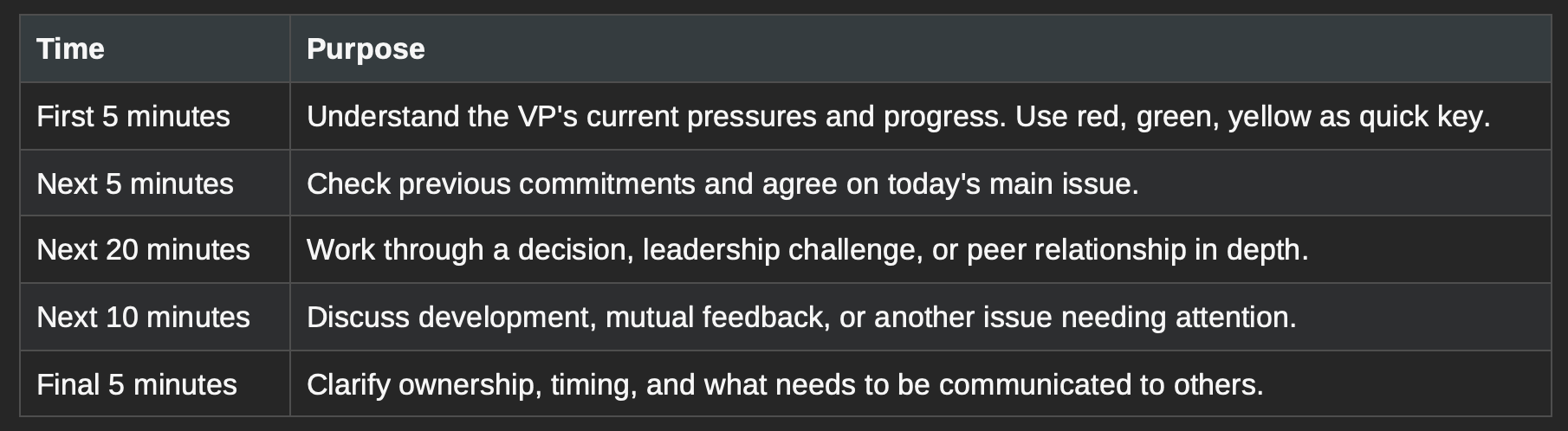
Close by recording what either of you has committed to do and what needs to be revisited. That may be a decision the VP will delegate, a conversation they will have with a peer, or a priority you will clarify. Some issues will need reflection before an action becomes clear; capturing the unresolved question gives you continuity without forcing a premature answer. The record should help both of you follow through, including on the commitments you made as the VP's manager. I explicitly call these out on my logs as commitments (they have a dedicated section at the top of the log before any session notes in which they are captured in the aggregate) that are easy to retrieve without having to review each individual past session.
After six weeks, ask which conversations helped the VP lead more effectively and which repeated work was already happening elsewhere. Look for changes you can discuss concretely, such as a director taking ownership of a recurring decision or a disagreement being addressed before it disrupts delivery. You may initially hear about more problems as the VP becomes more candid, so examine whether you are learning sooner and responding better. The evidence of progress should emerge in how the VP handles the next difficult choice, including when they can act independently and when they recognize that your involvement is necessary.