(This article is written for PE Managing Directors & Partners; if that’s not you, feel free to skip this article.)
You should be running your PE PortCo Board Meetings Like a Publicly Traded Company Earnings Calls.
For PE sponsors looking to get more from their board meetings, the public-traded company earnings call format offers a useful structure for connecting reported results to the decisions ahead. Consider a hypothetical software company that delivers its quarterly EBITDA target while implementation vacancies lengthen the time customers wait to go live. Circulating the results beforehand and keeping the retrospective concise gives you and your PortCo’s C-suite room to examine how those delays affect the renewal forecast and whether additional implementation capacity deserves funding.
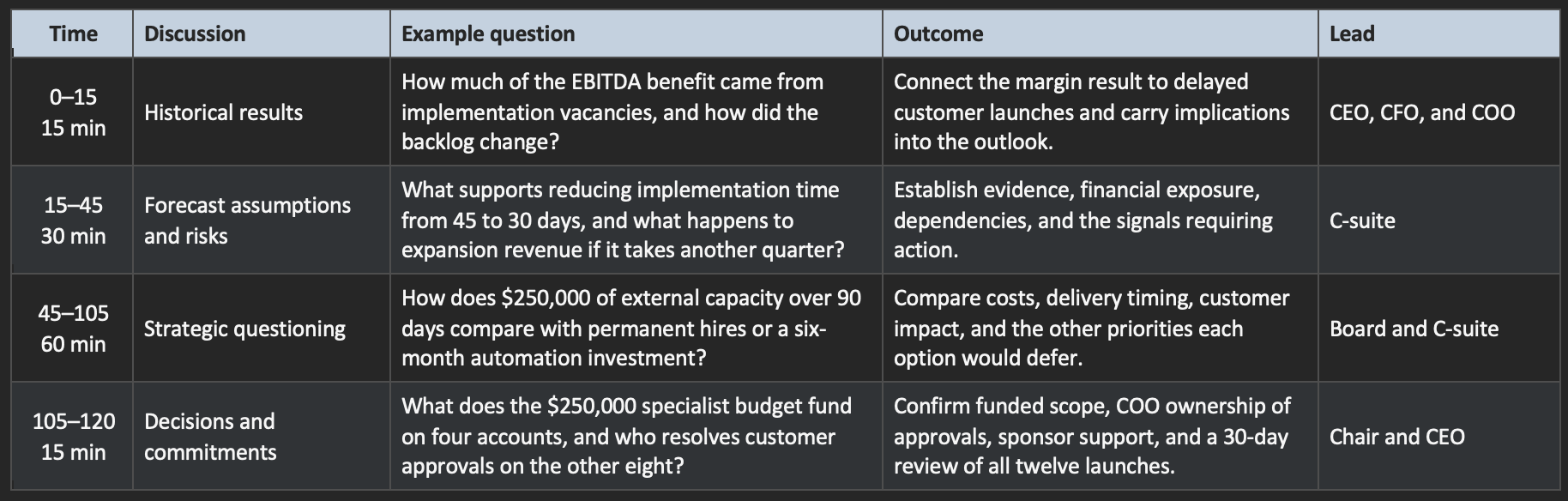
I recommend organizing the meeting into two hours, with fifteen minutes for historical results, thirty minutes for forecast assumptions and risks, sixty minutes for strategic questioning, and fifteen minutes to confirm decisions and commitments. Let’s say we have a hypothetical PortCo. In this PortCo, the CFO would explain the contribution of vacant positions to the quarterly margin, your PortCo CRO would examine the assumptions about customer activation, and the strategic discussion would evaluate ways to clear the backlog. Giving the forecast twice the time allocated to the retrospective creates space to understand the reasoning behind a proposed investment before agreeing on its scope and funding.
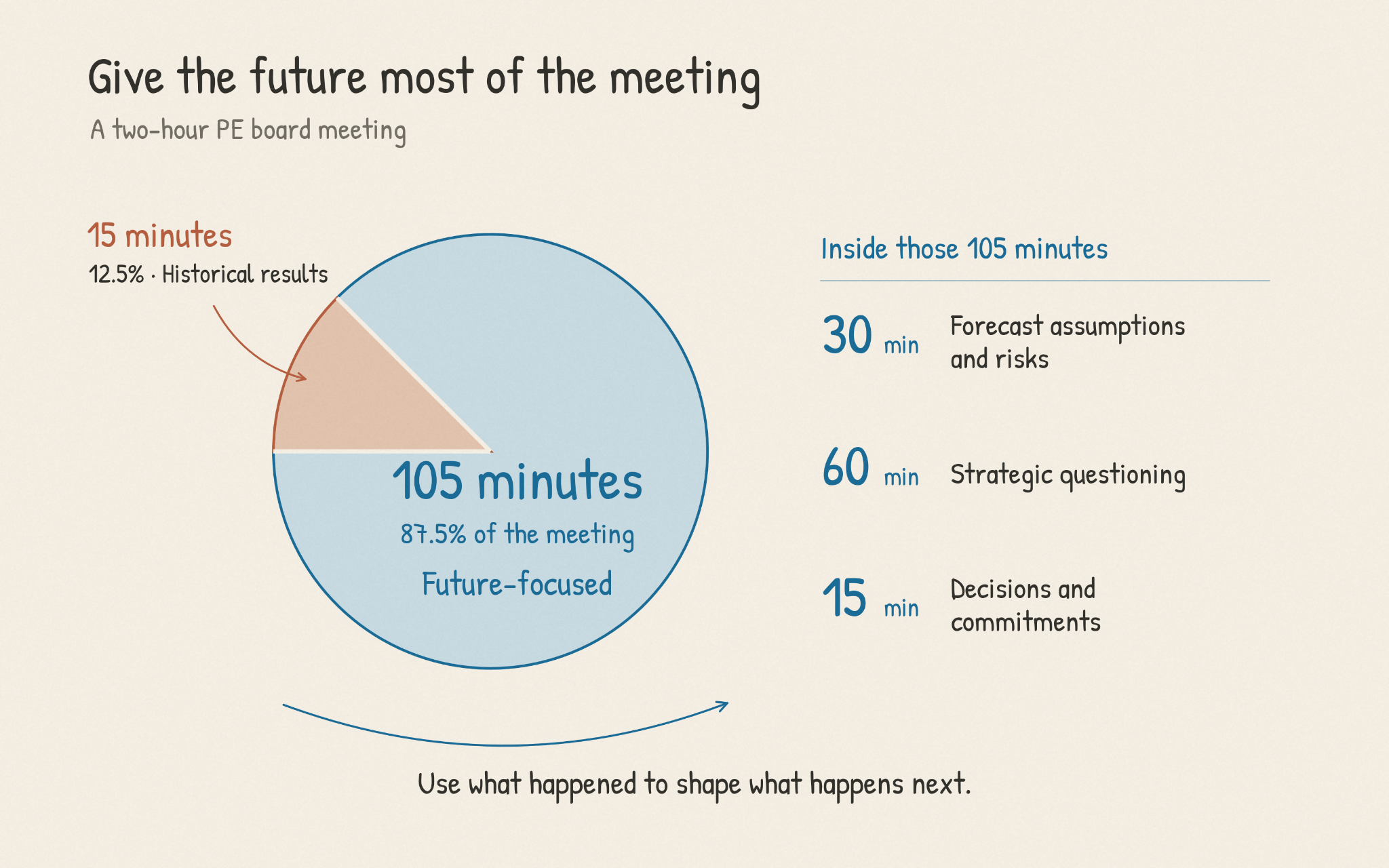
Research on portfolio-company boards helps explain the value of that shift. In Board Intelligence's 2019 study of 100 industry leaders, only about 30% of each respondent group considered their board meetings focused on creating value, while 51% said the information they received failed to identify emerging issues early enough. KPMG's 2022 survey of more than 250 portfolio-company directors found that 72% identified forward-looking agendas among the areas most needing improvement. For the software company in our example, including the age of unfinished implementations alongside recognized revenue would help directors examine whether the expected customer value is actually being delivered.
Public-company earnings calls provide a reference for allocating time to that examination. A 2024 study of twenty nonfinancial Dutch AEX companies found that their FY2023 calls averaged twenty-three minutes of prepared presentations and forty-one minutes of questions and answers, with 45% of questions addressing topics absent from the presentation. A sponsor can use the same opportunity to explore a renewal forecast that the presentation leaves unexplained, asking your PortCo C-suite how customers who have yet to complete implementation are being treated in the expected retention rate.
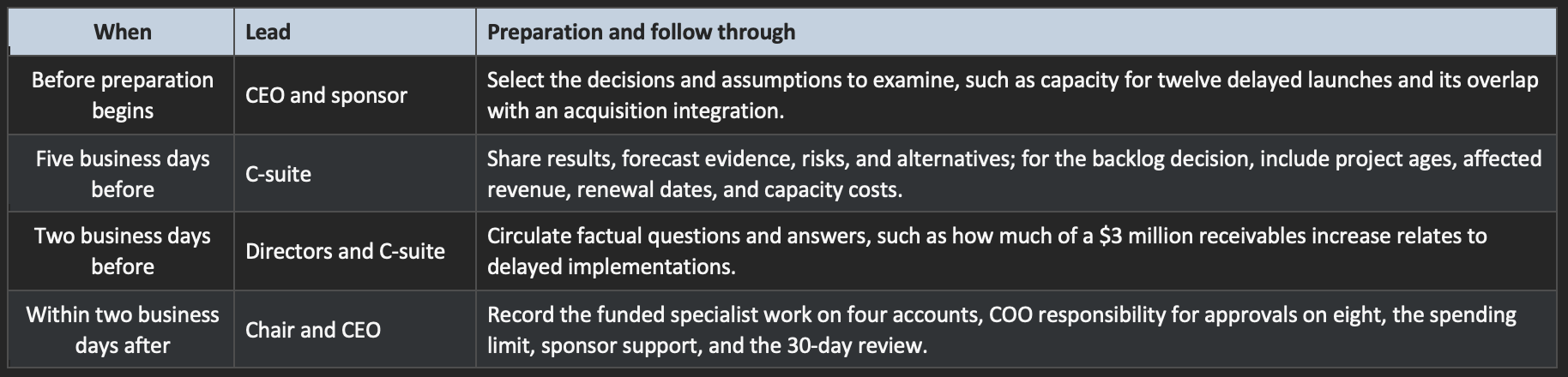
The starting point is a conversation with your PortCo CEO or President about the choices that would benefit most from the board's input. For this PortCo, you could agree that the next meeting will evaluate additional implementation capacity and the timing of an acquisition integration, since both require your PortCo CPO's attention and access to the same technical specialists. Identifying those choices before the reporting package is assembled gives your PortCo C-suite a clear reason to prepare the costs, dependencies, and alternatives that directors will need to assess.
Five business days before the meeting, circulate the financial results, updated forecast, and operating measures together with the CEO's assessment of what has changed. A brief supporting the implementation decision would show the age of the backlog, the contracted revenue associated with delayed launches, and the renewal dates of affected customers, alongside the cost and expected contribution of additional capacity. Including customer cohorts that completed implementation on time would give directors a basis for examining how activation relates to subsequent adoption and renewal.
Directors can make the live discussion more useful by sending factual questions two business days beforehand, allowing the CFO and relevant executives to investigate and share answers with everyone. If receivables have risen by $3 million, a director could ask how much relates to delayed implementations and whether the increase is concentrated in a few accounts. With that breakdown available before the meeting, the discussion can examine the implications for cash collection and customer commitments while your PortCo C-suite has the necessary account detail in hand.
During the fifteen-minute historical review, focus with your PortCo CEO and CFO on the exceptions that change your understanding of the business. In the software example, the CFO would explain how much of the EBITDA result came from implementation vacancies and how that compared with the original hiring plan, while your PortCo CPO would show the change in unfinished customer launches over the same period. Connecting those results establishes what happened and gives the forecast discussion a specific question to examine: whether the expected margin and retention remain achievable as the backlog develops.
The next thirty minutes should be devoted to the assumptions supporting the forecast and the risks attached to them, using the figures already distributed in the advance package. Suppose the outlook assumes that median implementation time will fall from forty-five days to thirty days, enabling customers to adopt additional products sooner. The CRO can explain which changes are expected to shorten the process, the CFO can show how the timing affects projected expansion revenue, and directors can examine what happens to that revenue if the improvement takes another quarter. Through my time as part of Amazon’s leadership team, I would recommend that the forecast primarily focus a majority of time on leading input KPIs as opposed to output KPIs (which should still be presented but not heavily discussed) as these input levers are ones that your PortCo’s C-suite can directly influence.
Keeping the target and forecast distinct makes it easier for your PortCo C-suite to discuss those dependencies openly. If the company generated $100 million in annual revenue, a 15% growth target would imply $115 million for the following year, while a current forecast of 8% growth would imply $108 million. The resulting $7 million gap gives you and your PortCo CEO a concrete basis for discussing inputs such as which customer launches, renewals, and new contracts would be required to reach the target, including when each would need to occur for revenue to be recognized in the year.
A useful question is which two or three assumptions account for most of the expected improvement and what evidence supports them. If the sales forecast assumes new hires become productive in four months, while eight of the last twelve hires needed six months, ask your PortCo CRO what has changed in onboarding, account assignment, or the sales process to support the shorter period. The PortCo C-suite can then explain the evidence from newer hiring cohorts and how the forecast would change if the six-month pattern continued.
For margins and cash, connect each expected improvement to the work required to deliver it and the consequence of a delay. Suppose an acquisition is expected to produce $2.4 million in annual cost savings, beginning at a steady $200,000 per month in July after systems are consolidated. A three-month delay would remove $600,000 of expected savings from that year before additional integration costs, giving the CFO and COO a specific exposure to examine together. That discussion can establish whether additional expertise would protect the timetable and what the company would need to postpone to make that expertise effective.
It is also useful to examine assumptions that share the same underlying risk, because several forecast lines can move together when customer conditions change. If many customers are healthcare providers (hypothetically speaking but can be applicable to any customer persona that has a rigid procurement cycle), their technology budgets could support new contracts, product expansion, and renewals across the same portfolio of accounts. A budget freeze affecting those customers would therefore require your PortCo C-suite to examine all three revenue streams together, including the timing of the effect and the cash available to support the company's investment plan.
Before moving into the strategic discussion, agree on the signals that would lead your PortCo C-suite to revise its view and the response each signal requires. For the implementation backlog, you could agree that your PortCo CPO will escalate when more than 20% of active projects have exceeded sixty days for two consecutive weekly reviews. The CFO would then reassess the revenue and cash assumptions attached to those accounts, while the CEO would decide whether additional capacity or revised customer commitments require board input. That gives everyone a defined way to respond as the forecast's underlying conditions change.
The following sixty minutes can use those findings to compare the choices available to the company. For twelve delayed customer launches, your PortCo C-suite might propose $250,000 of external implementation capacity over ninety days, additional permanent hires with a longer ramp period, or a product investment that reduces manual work over six months. Reviewing the cost, timing, and customers affected by each option gives directors a basis for assessing which investment addresses the immediate constraint and which improves the company's longer-term economics, including the other work that would be deferred.
Customer anecdotes help the board understand the constraints behind those alternatives. If your PortCo CPO walks through a delayed account and shows that it spent three weeks waiting for separate data-access approvals from the customer, directors can ask whether the other eleven delayed launches face the same obstacle. Establishing how widely that condition appears would help your PortCo C-suite assess the value of additional specialists and whether a clearer approval process agreed with customers would accelerate the launches. The example gives the investment discussion a specific cause to investigate and an outcome to measure.
The same discussion can examine whether your PortCo C-suite has enough capacity to carry the proposed initiatives through. If the CTO is accountable for both the acquired product's data migration and a new integration platform intended to shorten implementations, the board can review which technical dependencies overlap and where sequencing would help. Agreeing to complete the migration before expanding the platform investment would give the CEO a clearer delivery plan, with an explicit understanding of the customer benefits and revenue opportunities that move into a later period.
Your contribution as a sponsor belongs in that plan, with enough detail for your PortCo C-suite to incorporate it into execution. If an operating partner can provide a data-migration specialist for two days a week over eight weeks, agree on the start date, the work to be completed, and how the cost will be covered. Your PortCo CPO can then assign access and decision responsibilities, while the board records the sponsor's commitment alongside the company's own milestones and reviews both at the same checkpoint.
How you respond when an assumption weakens will influence the information your PortCo C-suite brings to future meetings. If your PortCo CPO discovers that the proposed automation addresses only four of the twelve delayed implementations because the remaining eight are waiting on customer approvals, a useful discussion would examine how that evidence changes the investment case. Working through whether to narrow the software scope, adjust customer onboarding, or redeploy the budget gives your PortCo CPO a clear route to update the recommendation while remaining accountable for the original reasoning and the response to new information.
Use the final fifteen minutes to confirm the decisions developed during the discussion and give each commitment an owner, funding, and a checkpoint. In this case, the board could authorize up to $250,000 over ninety days for specialist integration work on the four technically blocked accounts, with your PortCo CPO responsible for obtaining customer approvals on the remaining eight. The record would identify all twelve launches and require a thirty-day review of completed milestones, unresolved permissions, and spending, allowing the CFO to update the revenue and cash assumptions as evidence arrives. The operating partner's specialist commitment would appear in that record with its start date and deliverable.
Between quarterly meetings, monthly operating reviews and direct contact can carry the follow-through, with the agreed escalation signals guiding attention. At the first thirty-day checkpoint, your PortCo CPO could show that four launches are complete, three have firm launch dates, and five remain blocked by customer permissions, alongside the amount spent. That detail would allow the CEO and sponsor to assess whether the remaining budget is best directed toward implementation capacity, customer escalation, or a revised scope, while the CFO updates the outlook to reflect the progress actually achieved.
For your next board meeting, you can begin with one decision that exposes the connections between customer experience, financial expectations, and the resources required to deliver. Asking the CEO to bring a clear recommendation on the implementation backlog, supported by account-level evidence and the alternative uses of the proposed funding, gives the two-hour agenda a concrete purpose. The meeting should leave your PortCo C-suite with an agreed course of action, a clear understanding of the assumptions to monitor, and specific support from the sponsor as the work progresses.
A two hour board meeting framework:
The two hour meeting gives forecast assumptions and risks twice the time allocated to historical results. The examples follow the article’s software company as the sponsor and C-suite assess twelve delayed customer launches.
Preparation and Follow through: