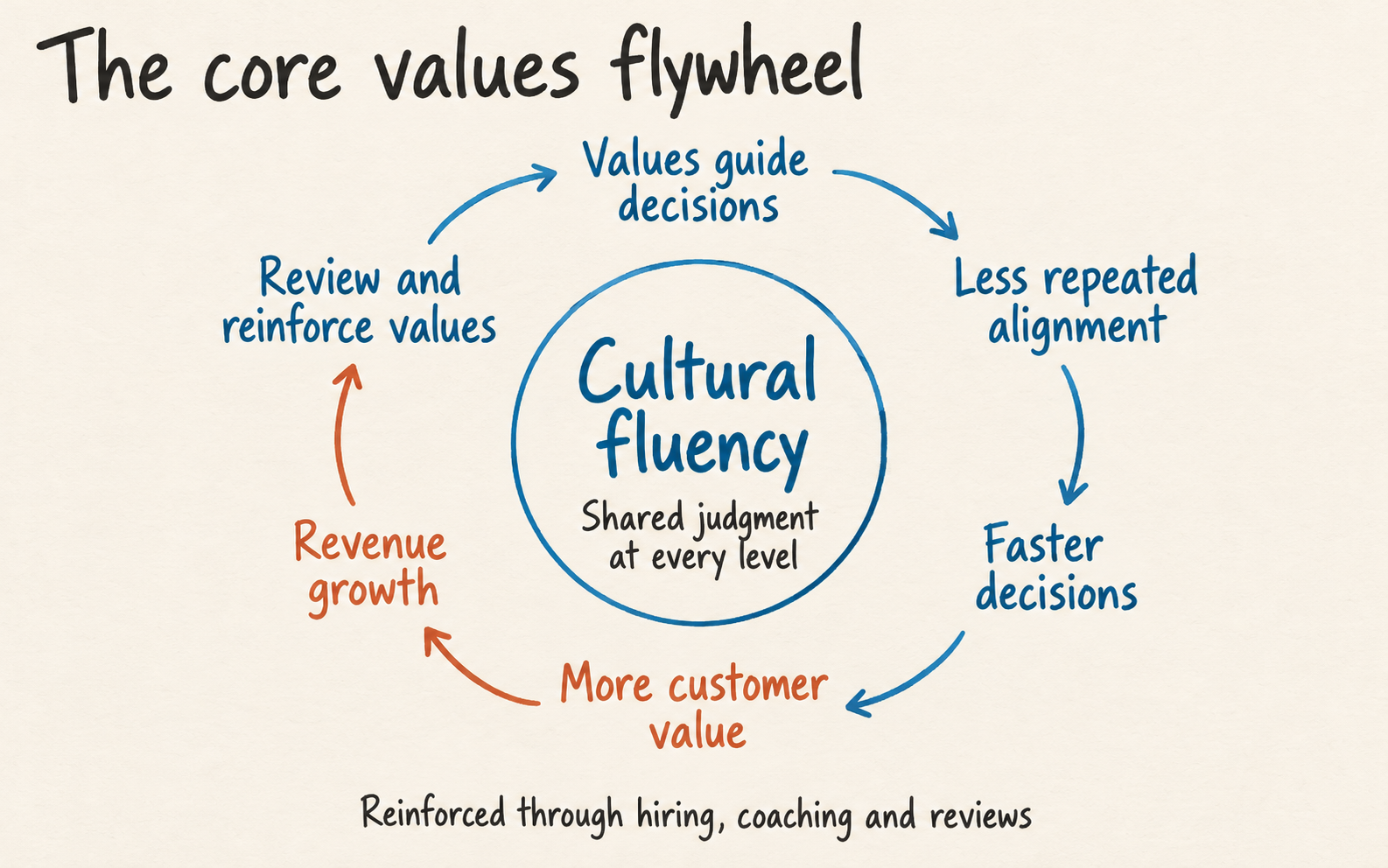
Your company's core values and culture mean nothing if they are not used rigorously and continuously throughout all levels of your organization as part of the daily decisions that your employees make.
When your company names customer trust as a core value, then approves a sales commitment it knows it cannot deliver, employees learn how much that value matters when revenue is at stake. The next salesperson facing a difficult quarter has a precedent to follow, regardless of what the C-suite said at the last company meeting. For those of us leading the business at the C-suite level, making values useful means establishing how they should influence decisions and checking whether that reasoning survives as decisions move through the organization.
Research by Luigi Guiso, Paola Sapienza, and Luigi Zingales helps explain why this deserves our attention. They found no significant relationship between advertised corporate values and the performance measures they examined, while employees' perceptions of management's integrity were associated with stronger business outcomes. I believe the implication for those of us in the C-suite is to examine the decisions employees observe, especially when honoring a stated value carries a cost.
A useful starting point is to take each core value and identify a recurring decision it should change. If customer trust is one of yours, agree on what a salesperson must disclose when a requested capability is still under development, including how uncertainty about delivery should appear in the proposal. A VP who reports to you should then be able to explain which otherwise attractive deals the company would decline under that standard. That conversation gives the value a consequence people can understand before they are under pressure to close.
A CEO deciding whether to enter a market with an unfinished product should describe its capabilities as accurately as the account manager discussing a renewal or the Director approving a proposal. Their decisions will differ in scope, and each will need appropriate authority, but the customer should encounter a consistent standard. If the CEO privately authorizes promises that a Director is expected to reject, the inconsistency begins with us.
Values also need enough definition to help people resolve competing priorities. A company that values both speed and quality could allow a limited pilot with minor usability issues while requiring unresolved data-integrity problems to delay the launch. The C-suite should make that distinction clear enough for a Director to act independently, including who can resolve a disagreement about the severity of a defect. Otherwise, both sides can invoke a different value while the decision waits for someone more senior.
Bring those decision criteria into hiring by asking candidates to describe occasions when a relevant value influenced a difficult choice. For a sales leadership role, ask about a time the candidate disclosed a product limitation that put a deal at risk, then explore what they personally did, which alternatives they considered, and what happened afterward. Follow-up questions should establish how much authority they had and whether they would handle anything differently now, helping you understand the judgment behind the story and its relevance to the decisions they would face in your company.
Use the same core questions for candidates pursuing the same role, with interviewers independently scoring the evidence against agreed descriptions of weak, acceptable, and strong behavior before discussing their assessments. A strong answer should demonstrate accurate disclosure under pressure, including how the candidate addressed the customer's needs within the limits of what could be delivered. Past behavior is a useful proxy for future judgment, although it cannot guarantee how someone will act under different incentives, authority, or circumstances. Your responsibility in the C-suite still means that you have to provide the conditions that support those values once the person joins, but by doing so from the hiring process and from the beginning, you are helping de-risk some level of cultural misalignment that may potentially manifest.
Toyota offers a concrete example of giving a principle operational authority. Its description of the Toyota Production System explains how an operator can pull an andon cord when an abnormality occurs, with the andon display signaling the problem. A software company can apply the same idea by authorizing an implementation specialist to pause a launch when required data checks fail. Supporting that judgment means funding the corrective work and explaining the delay to the customer, even when the launch was included in the quarter's forecast.
Once those expectations are clear, use your existing one-on-ones to understand how your VPs and Directors apply them. Ask a leader to walk through a recent decision where honoring a value made their job harder, including the alternatives they considered and the cost they accepted. If collaboration is a core value, a VP might reassign an engineer to another function's customer incident even though it delays their own milestone. Your discussion can examine why the customer impact justified that choice and whether the way you assess the VP's performance supports it.
For significant decisions, a brief explanation recorded before the outcome is known gives those conversations something reliable to examine. The VP in that example could include the reason for the reassignment and its expected effect on the milestone in the existing operating update. Netflix's culture memo describes a related discipline: a named owner seeks differing views, makes the decision, and reflects on the choice once its effects become clear. Recording the reasoning also makes it harder to attach a convenient value to a decision after the result is already known.
A retrospective should examine that reasoning using the information available at the time. If an honest explanation of a product limitation costs the company a deal, the review should establish whether the salesperson represented the limitation accurately and explored credible alternatives with the customer. Treating the lost deal itself as evidence of poor judgment would teach the next salesperson to conceal the problem. Equally, a contract that closes successfully after an unsupported promise deserves scrutiny while there is still time to correct the customer's expectations.
Broaden that review periodically by sampling decisions across functions and levels, including choices that produced good reported results. In a monthly operating business review, you might compare the handling of a billing error by a frontline employee, the response to a disputed renewal by a Director, and a pricing exception approved by the C-suite. Comparing their reasoning helps you identify unclear guidance or incentives that pull people toward a different standard. Agree on an owner and review date for any correction, while keeping subsequent decisions with the people authorized to make them.
Conversations with frontline employees help test whether the authority we describe is usable. An implementation specialist may understand the launch criteria perfectly and still expect their manager to override a pause because the customer is commercially important. In a skip-level conversation, ask them to reconstruct the last time they raised such a concern and what happened afterward. If the evidence shows that a manager routinely bypasses the criteria, the response needs to address that manager's decisions and the pressure behind them, with follow-up to establish whether employees can now raise the issue and act.
Annual employee growth plans should establish these expectations before performance is assessed. Alongside commercial or delivery objectives, agree on how the employee should use a core value in decisions and what evidence would demonstrate progress. For an implementation manager, a customer-trust objective could require early disclosure of delivery risks and accurate commitments to customers. Someone who still needs repeated reminders to raise known risks would have a clear development need, while consistently disclosing those risks early and making commitments supported by delivery evidence would meet the agreed standard. Readiness for broader responsibility could include helping colleagues make the same judgment on more complex accounts.
Revisit those expectations during quarterly growth conversations using decisions made since the last review, including feedback from the people affected. If the manager raised a launch risk promptly but lacked authority to resolve it, the discussion should identify what authority or support the C-suite needs to make available for the next case. Comparing actual cases against criteria agreed at the start of the year gives both sides a shared basis for judging progress, with time to coach and improve before the annual assessment.
Promotion and compensation decisions should follow the same standards because they show employees which behavior leads to greater authority and reward. Before promoting a sales leader who consistently exceeds quota, examine whether customers received what was promised and whether delivery colleagues raised concerns that the leader ignored. If unsupported commitments contributed to those results, address that behavior before expanding the leader's authority and review the incentives that encouraged it. A values statement loses credibility when the person who repeatedly violates it becomes the example of career success.
We at the C-suite level also need to make our own corrections visible. If you approved an aggressive delivery date and later learn that your approval encouraged others to suppress concerns, explain what you missed and how the decision process will change. That could mean revising the customer commitment, restoring the Director's authority to pause delivery, and changing the forecast assumptions that created the pressure. Your response gives employees evidence about whether accountability reaches the people with the most power to make exceptions.
At your next C-suite business review, choose one core value and examine a recent executive decision alongside a related frontline decision. Use any difference in reasoning to clarify the standard, adjust the authority or incentives involved, and agree on which subsequent decisions you will revisit. As that habit becomes part of your operating rhythm, your VPs and Directors gain a more dependable basis for exercising judgment, and employees can understand how the company's core values should guide a difficult choice before it reaches your desk.