Your next big bet might threaten your best business. Take it.
Some of the bets that helped me reach the C-suite looked counterintuitive when I made them. They required me to commit to a view of the future before I had enough evidence to make the decision comfortable, knowing that I would be judged harshly if I got it wrong. That experience has shaped my belief that executive leadership requires a willingness to invest while uncertainty is still high, including when the opportunity challenges the business you're responsible for running.
I thought about this during a conversation with an Amazon SVP around 2022, as ChatGPT was changing the discussion about generative AI. I've left the executive unnamed, but their position was straightforward: Google wouldn't build a competitor because its search business depended on advertising revenue. A product that changed how people found information could threaten that business, so they believed Google had too much to protect to pursue it.
I understood the concern, but I fundamentally disagreed with the conclusion. Google's desire to preserve its business model couldn't prevent another company from developing technology that threatened it. If generative AI changed what customers expected, Google would have to respond regardless of how uncomfortable that response might be for its existing business.
My perspective came partly from having worked with early GPT models in 2018 and 2019 on psychometric evaluations, quiz generation, educational content, and compliance training for federal and state governments leading AI at the C-suite level. The subsequent progression from GPT-2 to GPT-3 influenced how I thought about the technology's potential. By the time ChatGPT arrived, I had already spent years considering practical applications, and I believed the pace of improvement warranted bets that would have been difficult to justify through the economics of an existing product alone.
Google went on to introduce Bard in 2023 and rename the chatbot Gemini in 2024. Its decision to enter the category contradicted the prediction that protecting search would keep it out, although entering the market was only the beginning of the work required to compete.
What stayed with me about that conversation was how easily a sound observation about an incumbent's incentives could become an argument against its ability to change. At the executive level and especially at the C-suite level, you spend so much time protecting revenue, improving margins, and scaling successful products that an investment which threatens any of those things can seem irresponsible. Yet those same responsibilities require you to consider whether the business will remain competitive three to five years from now.
That's why I've approached corporate investment as a portfolio of bets. Most resources should support the core business, where the company has customers, operating experience, and a clearer understanding of returns. Alongside that investment, there needs to be a meaningful commitment to opportunities that could change how the company creates value, even if success would come at the expense of an existing product.
An 80/20 allocation offers a useful starting point for that discussion: roughly 80% devoted to the core and 20% to more uncertain opportunities. The allocation needs to fit the company, but the underlying commitment matters. If every proposed investment has to reinforce the current business model, you've already constrained the company's future to what works today.
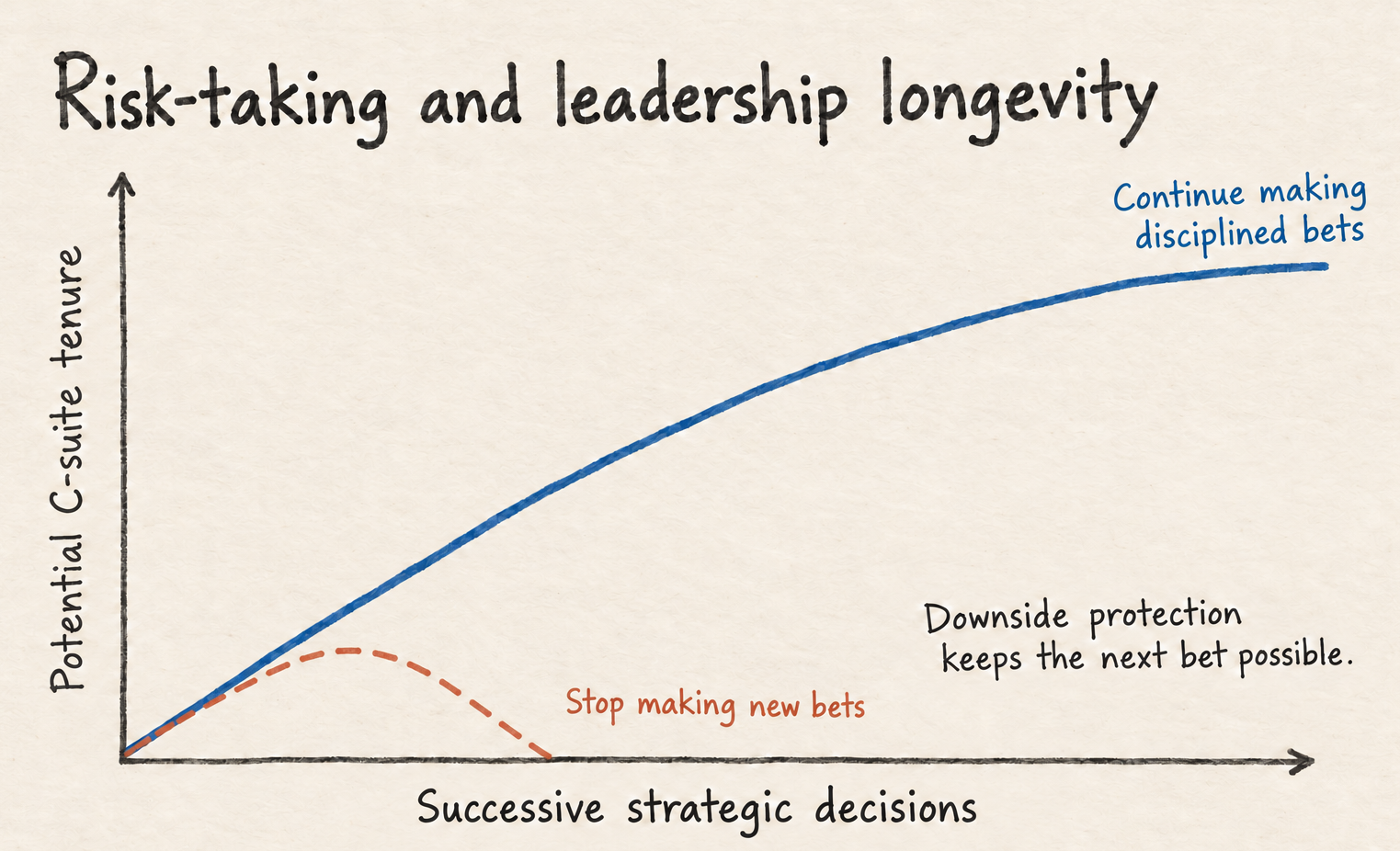
This is analogous to investment banking. For managing directors responsible for allocating capital, this raises a familiar question about which risks belong in the portfolio and which should be hedged. Investment bankers structuring protection for clients and investment managers deploying capital have different mandates, but both have to evaluate the relationship between the exposure, the protection, and the economics that remain. Before committing capital, I evaluated the downside we could absorb, the investments that could fail together, and the liquidity required to carry those commitments through an adverse period.
The economics of the hedge belong in that assessment from the outset. Purchased option protection requires a premium, while financing that protection by selling calls gives up upside above the relevant strike price. Those trade-offs can be entirely appropriate, provided the remaining return potential justifies the capital committed. If the protection becomes so expensive that the investment no longer meets the mandate, the investment committee needs to reconsider the sizing, the structure, or the underlying opportunity.
A portfolio built to generate returns still needs deliberately chosen sources of return after its hedges are in place. Each hedge should address an identifiable exposure, with its cost assessed against the protection it provides; accumulating defensive positions without that discipline can consume the economics the portfolio was designed to capture. My objective has been to protect the company's capacity to withstand losses while retaining enough exposure to well-underwritten opportunities for success to matter.
I've applied the same reasoning to corporate strategy, while recognizing that a new venture offers no contractual protection against a decline in the core business. It may eventually reduce the company's dependence on that business, but both could struggle at the same time, particularly if they rely on the same customers, funding conditions, or technology assumptions. Calling an investment a strategic hedge therefore doesn't relieve us of the obligation to underwrite it independently. In practice, I've sized initial commitments, established what evidence would justify further capital, and preserved the ability to stop funding an investment if its thesis deteriorated.
In my own career, being willing to pursue counterintuitive bets helped me advance into the C-suite. That experience also made me appreciate how exposed I was when making those decisions. I was committing resources based on incomplete information, often before the market had made its direction clear, while accepting that others would eventually assess my judgment with the benefit of knowing how things turned out.
I've remained accountable for those decisions, because uncertainty didn't remove that responsibility and a decision wasn't intelligent simply because it was risky. That responsibility has never changed my view that requiring enough certainty to make criticism unlikely can delay an investment until much of the opportunity has passed.
The portfolio approach matters because individual moonshots can fail even when there is a reasonable case for pursuing them. I've thought of one meaningful success in ten as a useful illustration of how uneven the results can be, provided that success is substantial enough to justify the investment across the portfolio. One such outcome can define an executive's career, which creates its own temptation to protect the reputation built around it.
My concern has been that executives can become increasingly reluctant to make the kinds of decisions that helped them advance. After a major success, another uncertain bet brings the possibility of losing credibility, and explaining that risk to shareholders or colleagues can feel harder than continuing to fund a familiar business. Over time, concern about how a decision will be perceived can narrow the investments a leader is willing to consider.
I've treated explaining the investment as part of the work itself. People needed to understand what I believed was changing, why the company needed to commit resources at that point, and how the opportunity related to its future. As the work developed, I had to update that explanation to reflect what we were learning, including evidence that challenged the original decision.
For me, the difficult question has been whether I was willing to support a credible opportunity while the outcome remained uncertain and the consequences were mine to answer for. The bets that helped me reach the C-suite required that willingness, and I've carried the same discipline into the greater responsibilities that came with it: committing resources to the company's future before anyone could tell me with confidence what that future would look like.